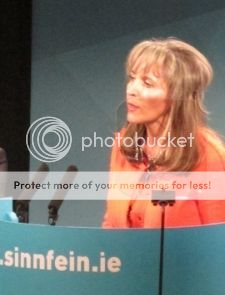
Senator Kathryn Reilly in London to outline implications of a British exit from the EU for the Border

Sinn Fein

ReillyToday at the London launch of the Joint Oireachtas Committee on European Union Affairs report on the implications for Ireland of Britain leaving the European Union, Sinn Féin Senator Kathryn Reilly outlined the extreme impact this would have on the Border region.
Addressing British officials, Senator Reilly stated:
“The importance of this report and the recommendations made should not be underestimated. It is crucial that we start the debate on the implications for Ireland of a British exit from the EU as soon as possible.
Such an eventuality would be devastating for the Border region in particular. It would see the reintroduction of check points, passport controls, custom checks, and many other negative measures.
The economy of the whole island would be damaged, and this would no doubt be worsened in the Border region. The free movement of goods and services would no longer exist in its current format across the Border. This would have significant implications for trade and employment, it would also affect families and communities, and it would reinforce partition even further.”

Senator Reilly concluded:
Reilly&Molloy“Sinn Fein is committed to seeing Britain remain in the EU, it is in the best interest of citizens in the Border regions, it is in the best interest of all the citizens on the island of Ireland, and it is in the best interest of Britain and the EU.
We as a party will be actively campaigning for a no vote in the upcoming referendum and we will seek to have special treatment afforded to the north so the people of the six counties can decide their own future for themselves.”

Martin McGuinness’s address to London anti austerity rally

Yesterday deputy First Minister Martin McGuinness took part in the End Austerity Now demonstration in central London, the following is his address to the rally:

McGuinness“I am delighted to be here and I bring solidarity from Ireland and from all of us fighting right wing Thatcherite policies on both sides of the Irish sea.
Sinn Féin is an anti-austerity party.
We stood for election on an anti-austerity platform and we are mandated by our electorate to oppose austerity.
Sinn Féin is in coalition government in the North of Ireland. I am the deputy First Minister in that government. And in government we blocked the Welfare Bill and the welfare cuts that the Tory led coalition demanded we impose on the most vulnerable.
We said no to the coalition government and we are saying an unambiguous, unqualified and uncompromising ‘no’ to this new Tory government.
The Tories have no mandate for austerity in the north of Ireland. They stood in the elections and they were trounced in every constituency.
But in Britain the Tories were elected on the lowest share of the vote ever for a Tory government – just 24 per cent of the electorate. 24 per cent is no mandate for austerity.
Sinn Féin will not do Tory austerity. Unlike the Tory millionaires, I live in the heart of the proud working class community of the Bogside in Derry. The people the Tories are targeting are my friends, my neighbours, my family. They are fine, hard-working, proud and decent – just like our people in working class unionist communities.
They are not parasites or spongers. It is Cameron’s cabinet of millionaires who are the real spongers given free rein to live out their Thatcherite fantasies at the expense of ordinary, decent communities throughout these islands.
Austerity is devastating these communities.
The working poor, public sector workers, the disabled and the vulnerable are the hardest hit by this bankrupt and ideologically driven policy.
In the North of Ireland, where we continue to build the peace and a fragile economy, their policies threaten the power-sharing institutions of the Good Friday agreement.
Those institutions – which have underpinned the peace process for almost two decades – are now on the brink of collapse because of Tory recklessness.
In the south of Ireland we have witnessed at first hand the brutality of austerity. The debts of private business, of banks and developers were passed on to the people.
Generations will be paying of the debts of the greed of the few.
Austerity has failed. It has failed our young people, our public services and our economy.
It is the communities of Dublin, Derry, Dundee, Cardiff and London that are paying the cost of Tory austerity while the wealth of the few continues to increase.
Austerity means inequality, poverty and despair.
McGuinnessThe alternative is investment and growth, equality and prosperity, the safety net and the helping hand.
I am heartened by the huge numbers here today. Because it reminds us all that we are not alone in this fight. We are strong if we unite and act together.And, by continuing to stand together, we can succeed.
Defeat is not an option. Austerity is not an option.
Today we send a powerful message to the Tories that we will not be cowed, threatened, bullied or bribed.
I congratulate you all for taking this stand and I look forward to continuing to stand shoulder to shoulder with you during the days, weeks and months ahead.”

Martin McGuinness to address major anti-austerity rally in London

Sinn Fein

McGuinnessSinn Féin MLA Martin McGuinness has said the austerity policies of the British government are responsible for the current crisis facing the devolved Assembly in the north of Ireland.
Speaking ahead of addressing a major anti-austerity rally in London on Saturday, Mr McGuinness said:
“The policies being pursued by a cabinet of millionaires at Westminster are an ideological attack on the working class and are having a devastating impact on the most vulnerable in our society and on our public services.
The austerity policies of the British government have brought our devolved institutions to the brink of collapse. The real crisis for our Assembly and Executive is Tory cuts.
The slashing of £1.5 billion from our block grant by the Tories is severely impacting the Executive’s ability to deliver public services.
Sinn Féin have been absolutely clear in our opposition to Tory cuts and we are encouraging others to join together to present a united voice against austerity. We have blocked their welfare cuts, the bedroom tax and the targeting of people with disabilities.
Sinn Fein will continue to resist the anti-working class agenda of the British Tory party.”

Tory austerity restricts opportunities for all our young people – Declan Kearney

Sinn Fein

KearneySinn Féin national chairperson Declan kearney has said that tackling educational underachievement should be addressed as a priority on a cross community basis.
Speaking after attending the launch of the Firm Foundations report in east Belfast today, Mr Kearney said;
“Education is the key to unlocking the potential of the future for all our young people.
The decimation of key public services by the Tory austerity agenda does not recognise communal divisions. With respect to education, the cumulative cutting of our Block Grant means that early years and direct primary and secondary education service provision are not adequately meeting the needs of our young people, and especially those from the most deprived areas in the north. Tory austerity is undermining educational provision and that directly restricts the development of educational opportunities and options.
Tackling educational under achievement in particular requires targeted investment, a multi agency focus, the involvement of employers organisations and social partners, and the support of the entire community in promoting the best learning environments and opportunities for young people at primary and secondary levels.
All of us in society should be working to ensure that our young people have full equality in realising their educational and creative potential. That should mean uniting on a non sectarian basis to challenge the injustice of austerity and building on the common ground which is the educational futures of all our children.”

Progressive parties must work together to oppose austerity – Martin McGuinness MLA

Sinn Fein

SF/SNPDeputy First Minister Martin McGuinness has said it is important for progressive political parties to work together to oppose the austerity agenda of the Tory government.
Speaking after a meeting with Scottish First Minister Nicola Sturgeon, Mr McGuinness said;
“Today’s meeting was an opportunity to explore matters of mutual concern across these islands, particularly the need for a broad-based campaign of opposition to the Tory cuts agenda.
We are keen to work together to develop a collective opposition to the austerity-driven policies coming from Westminster.
There are various areas where we share positions and these should be explored as we move forward.
In addition to our common opposition to the austerity policies of the British government, we share concerns about David Cameron’s plans to scrap the Human Rights Act and the prospect of a break from the European Union.
We had a positive meeting today and I look forward to building on our relationship in the future.”

Week in Review 11-18 June 2015‏

Sinn Fein
The Week in Review
11 – 18 June 2015

Martin McGuinness to join London anti-austerity rally:
‘Tory austerity policies responsible for current crisis’

McGuinness
Sinn Féin MLA Martin McGuinness will travel to London on Saturday to join anti-austerity campaigners, politicians, trade unions and community groups at a major demonstration against austerity.
Martin McGuinness repeated assertions that the austerity policies of the British government are `responsible for the current crisis facing the devolved Assembly in the north of Ireland’.
Speaking ahead of addressing the anti-austerity rally in London on Saturday, Mr McGuinness said `the policies being pursued by a cabinet of millionaires at Westminster are an ideological attack on the working class and are having a devastating impact on the most vulnerable in our society and on our public services’.
He said the British government’s austerity policies had `brought our devolved institutions to the brink of collapase. The real crisis for our Assembly and Executive is Tory cuts’, adding `the slashing of £1.5 billion from our block grant by the Tories is severely impacting the Executive’s delivery to deliver public services.
He said Sinn Féin had been `absolutely clear in our opposition to Tory cuts and we are encouraging others to join together to present a united voice against austerity’. Sinn Fein had `blocked their welfare cuts, the bedroom tax and the targeting of people with disabilities.
He concluded `Sinn Fein will continue to resist the anti-working class agenda of the British Tory party.’

    End austerity march, Saturday 20 June, is organised by the People’s Assembly Against Austerity, and assembles 12 noon at Bank of England (Queen Victoria Street), marching to Parliament Square. Martin McGuinness will be among speakers at the Parliament Square rally at the end of the march.

Tory cuts `driving people deeper into poverty’Murphy
On 17 June Sinn Féin MLA Conor Murphy said the British government’s assault on public services will `drive people deeper into poverty’.
Mr Murphy strongly criticised comments by Chancellor George Osborne as `ludicrous… that welfare reforms being driven by his cabinet of millionaires is releasing people from the poverty trap when the reality is their assault on welfare and public services in driving people deeper into poverty’.
He added, `it is rich for him to talk about limits which have been agreed with the British government when no one in the North agreed to £1.5 billion being raided from the block grant.’
He concluded: `the difficulties currently facing the Executive are not of our making. The responsibility rests solely with the austerity policies of the British government. The real crisis for the Executive is Tory cuts.’

Labour `out of step with growing anti-austerity opinion’Kearney
Earlier, Sinn Féin national chairperson Declan Kearney rejected a call from British Labour spokesperson on the North of Ireland, Ivan Lewis, to support the British government’s austerity agenda.
Mr Kearney said Ivan Lewis’ latest public comments on the austerity crisis and increased political instability facing the North were `now virtually indistinguishable from the rhetoric of British Tory spokespersons’.
He added, `he refuses to recognise that the austerity crisis in the North has been created by a net cut to the local block grant of £1.5 billion to date, and another estimated £800 million between now and 2018. That represents a continuous net loss of £2.3 billion to the regional economy, largely between 2014 and 2018’.
He said that contrary to the Labour spokesperson’s assertions, `a viable budget cannot be formed on the basis of his advised acceptance of “savage cuts”’, adding `his singular focus on the welfare impasse chooses to ignore that welfare cuts are a by-product of the austerity crisis, not the cause’.
Declan Kearney also said that this support for the cuts was `out of step with a growing body of academic and economic opinion which rejects austerity as an option’.
He said the North was `a special case with special economic and social circumstances emerging from conflict’ and added `the Executive parties, social partners and all stakeholders in civic society should unite to secure a workable budget and to prevent the austerity crisis triggering an unprecedented political crisis.’
He concluded: `Ivan Lewis should be supporting, not undermining that objective.’

Sinn Fein host London meeting: `Uncomfortable Conversations – an initiative for dialogue towards reconciliation’Conversations
On Tuesday 14 July, Sinn Fein MP Pat Doherty will host a London meeting, `Uncomfortable Conversations – an initiative for dialogue towards reconciliation’. Speakers will include Sinn Fein national chairperson Declan Kearney, Lord John Alderdice, Irish in Britain Chief executive Jennie McShannon and others to be confirmed
The event takes place at 7.00pm in the Wilson Room, Portcullis House, Westminster.
Pat Doherty, announcing the meeting said that Sinn Fein `firmly believes that the need for reconciliation across our society, and between these islands, must represent the next phase of the peace process’. He said the recent visit of Princes Charles to Ireland, `and the remarks on that occasion by both himself and the Sinn Fein leadership has, in our view, shown the potential of what could be achieved if everyone across society works collectively towards a shared and agreed future’.
He said that as part of Sinn Fein’s contribution to this process, in March 2012, the Sinn Fein newspaper `An Phoblacht’ carried an article by the party’s national chairperson Declan Kearney, entitled ‘Uncomfortable conversations are key to reconciliation‘, setting out Irish republicans’ view on these issues. This sparked a discussion which has continued with a large and varied range of contributions from key figures in the churches, academia and wider civic society as well as senior republican figures, which have recently been published in book form.
For further details or to attend email jayne.fisher@parliament.uk. All welcome.

Sinn Fein urge action on migrant crisisAnderson
On 18 June Sinn Féin MEP Martina Anderson urged the international community to do more to tackle the migrant crisis in the Mediterranean which has already claimed the lives of thousands.
Speaking from Lampedusa, Sicily, as part of a GUE/NGL delegation to see the impact of the migrant crisis at first hand, Ms Anderson said the scale of the migrant crisis in the Mediterranean `demands immediate humanitarian action from the international community’.
More than 2,000 migrants fleeing violence and poverty have already died making the Mediterranean crossing this year, she said, and many more have been rescued from the sea.
She said `many of those who are rescued are taken to taken to reception centres in Lampedusa, including one for children who have made the crossing alone or lost their parents’.
`No one who has visited those reception centres could fail to be moved by the harrowing experiences of the migrants, both during the crossing and the circumstances that led them to make such a perilous journey’ Ms Anderson said, adding `others have been returned to the horrendous conditions they sought to escape. Detaining migrants in Sicily or returning them to war zones is not the way to deal with this crisis. Any response must be based on humanitarian grounds.’
She concluded: `The international community, and the European Union in particular, must take immediate humanitarian action to prevent further deaths in the Mediterranean.’

Week in Review is circulated by Sinn Fein MPs. Email jayne.fisher@parliament.uk to join the list. For further information visit www.sinnfein.ie or follow us on twitter @sinnfeinireland

Tory government ideologues on collision course with Good Friday Agreement – Declan Kearney

By Declan Kearney in June News Bulletin

KearneyJOSEPH Stiglitz and Paul Krugman are both internationally acclaimed and Nobel Prizewinning economists. Each has advanced robust critiques against austerity. Promoting his book, The Great Divide, in London recently, Stiglitz said bluntly that austerity doesn’t work and had been bad for the Irish economy.
Both Stiglitz and Krugman (and other renowned economic thinkers, including Yanis Varoufakis, the Greek Finance Minister) are providing an important counter to the argument that austerity is the only way to repair economies in the aftermath of the financial crisis. They also dispute a narrative, camouflaged in the rhetoric of ‘realpolitik’,that the economic pain is unavoidable and should be accepted.
David Cameron’s new Tory Government is seized with an ideological worldview of how politics, society and the economy must be
organised. They have made austerity central to achieving their aims.
Other elements of this Tory agenda include:

    ● An intention to increase military spending (including a proposal to spend over £20billion on the Trident nuclear missile system, whilst simultaneously cutting over £25billion from public expenditure between 2015 and 2017);
    ● A plan to dismantle human rights legislation;
    ● An intention to introduce anti-trade union measures;
    ● An ill-conceived referendum on an exit from the EU.

Cameron’s new Cabinet is an exclusively neo-Thatcherite government dedicated to less state intervention, an end to the welfare state, and unprecedented levels of political authoritarianism in Britain.
All of that has very serious ramifications for the Six Counties.
Cameron’s previous government started to disengage from the Northern political process from 2010. It became increasingly partisan and negative in its interventions. The Tory-led coalition also introduced policies which cut the North’s public expenditure settlement (or Block Grant) by £1.5billion and unleashed the austerity crisis now gripping the regional economy.
British Tory political and economic policy towards the North is the context against which the DUP’s welfare legislation has been blocked twice by Sinn Féin, SDLP and the Green Party. The ongoing welfare impasse is one manifestation of this much wider austerity crisis.
During the last three weeks, DUP representatives have tried to argue that continued opposition to their welfare
legislation will create a “black hole” in the local economy. That completely ignores and distracts from the fact that a “black hole” of £1.5billion already exists.
That is the reality which has already been driving down living standards in the North (already the lowest in the British state and 26 Counties), entrenching public sector wage restraint, increasing dependency upon food banks; and further decimating already hard pressed health, education, training, higher education, and other key public services.
The threats now being issued that failure to pass the legislation could lead to senior civil servants taking control of departmental budgets and that welfare powers should be handed back to Westminster have been further exacerbated by Secretary of State Theresa Villiers’s public statement in May raising the prospect of Westminster “action”.
The biggest threat to the political process during the last five years has been the
approach of the British Government.
As a result of the austerity crisis created by the previous Tory/LibDem coalition and the announcement that worse is to come, the potential now exists for an unprecedented political crisis to engulf the political institutions and the process itself. The new Tory Government’s unyielding ideological crusade is the main negative dynamic pushing the North gradually towards that outcome.
This British Government needs to change its approach to the North. The political institutions established under the
Good Friday Agreement (GFA) were intended to embed the Peace Process and take forward economic and social reconstruction and regeneration. They must not be reduced to instruments for imposing policies which will mean more economic inequality and hardship.
It appears that the Tory ideologues now in government and their commitment to austerity are set on a direct collision with the entire basis of the Good Friday Agreement. That should be a cause of alarm for all those who have supported the Good Friday Agreement and subsequent Agreements – North and South and internationally.
British Government policy has taken the political process for granted. Its role in contributing to political instability and the emergent austerity crisis is a total anathema to all democrats.
Tory candidates who stood for election in the Six Counties at the last election received a derisory vote. This Tory Government has no mandate for its policies in the North of Ireland.
A defining period is opening up for the political process and the economy in the North. Each must be reenergised with substantial positive investment not pushed into a negative downward spiral. Progressive leadership and initiative will be required both in Ireland and internationally to ensure there is forward momentum.

British Tory austerity crisis now threatens political institutions – Martin McGuinness MLA

By Martin McGuinness MLA in June News Bulletin

McGuinnessWE ARE facing into a building crisis in the political institutions in the North of Ireland. However, the crisis we are facing is not of the making of the parties in the Executive.
The crisis has been created by the austerity cuts agenda of a Tory administration in London, which is attempting to decimate our public services and punish the most vulnerable people in society. Sinn Féin stood in the recent elections on May 7 against Tory austerity and for social justice and equality. Our approach was mandated by over 176,000 voters, almost 25 per cent of the popular vote.
In contrast, the Tories received only 9,000 votes in the North, just over one per cent of the vote. This is a party that doesn’t have a single Assembly or local council seat. They have no democratic mandate for their austerity policies in the North of Ireland.
Yet they have already taken £1.5 billion from the Executive’s block grant – 10% of our budget. And Cameron’s cabinet of Tory millionaires have announced plans for further eye-watering cuts of £25 billion to our public services and to welfare protections for people with disabilities, the long-term sick and large families.
These new cuts are set to begin almost immediately and they will devastate our core
public services. In meetings following the elections I challenged the British Secretary of State Theresa Villiers on two occasions for a breakdown on how the proposed £12bn cut to welfare and £13bn cut to public services would impact on the people of the North. She refused point-blank to tell me, despite indications the Tories are even prepared to tax Executive top-up payments for the most vulnerable.
That is unacceptable to Sinn Féin.
We made it very clear in our election manifesto that the Executive needs a viable budget for frontline public services and welfare protections for the most vulnerable.

Welfare Bill
The immediate difficulties we are facing into were triggered by the Democratic Unionist Party’s decision to bring forward a welfare bill to the Assembly, which does not implement the protections agreed at Stormont House for children with disabilities, adults with severe disabilities, the long-term sick and large families.
The DUP was responding to pressure and demands from the Tories in London. In my view that is a major tactical error.
Sinn Féin has moved a Petition of Concern (the power-sharing veto mechanism) to stop the passage of the Welfare Bill in May. The SDLP has now supported our position. I urge the DUP to withdraw the bill and re-engage in the negotiations to achieve the implementation of the welfare protections agreed at Stormont House.

Executive unsustainable under these cuts
Sinn Féin will not support a welfare bill that does not contain those protections and we will not be part of any agenda that punishes the poor and dismantles public services. In my view the measure of any society is how it treats those most in need and those most vulnerable.
In the face of such devastating Tory cuts our public services, our welfare system, our departments and the Executive itself is not sustainable.
None of the Executive parties stood on a platform of implementing these Tory cuts and Sinn Féin will not abandon children with disabilities, adults with severe disabilities, families with children and the long-term sick.
It has always been my view that the outstanding issues in the welfare bill can be resolved but this requires political will, particularly on the part of the unionist parties, to protect the most vulnerable.
The biggest threat to our political institutions remains the ongoing Tory austerity agenda of cuts to our public services and the welfare state.
This is a time when the Executive parties need to stand together to defend our public services particularly in health, education and welfare. We need to stand up for the people who elect us, rather than acting in the interests of a Tory elite.
We need an immediate negotiation with the British government for a budget, which protects our public services and for fiscal powers that give us control over our economy.
We are not alone in this battle against austerity. The Scottish Executive has already requested a tripartite meeting of the representatives of the Scottish, Welsh and local Assemblies.
We should be taking this offer up and developing a common position within the Executive and with the Scottish and Welsh Assemblies in opposition to Tory austerity.

British government must release Dublin and Monaghan bomb files – Martin McGuinness MLA

Sinn Fein

McGuinnessSinn Féin MLA Martin McGuinness has called on the British government to release all files it holds on the Dublin and Monaghan bombings.
Speaking after a meeting of the North South Ministerial Council in Dublin, Mr McGuinness said;
“At today’s meeting of the North South Ministerial Council I called on the British government to release all files relating to the Dublin and Monaghan bombings in 1974 which claimed the lives of 33 people, including a pregnant woman.
The families of those killed and injured in the attacks deserve justice and we will continue to support them in their campaign.
The current difficulties facing the Executive were also discussed. I made it clear that the protection of the most vulnerable in society from the onslaught of the Tory cuts agenda remains a priority for Sinn Féin.
There is a need for all Executive parties to adopt a common approach to challenge the British government whose austerity policies are at the heart of the current challenges we face.
An Taoiseach Enda Kenny is due to meet David Cameron later this month. I would urge both men to remember the responsibilities they have in upholding and implementing the Good Friday and subsequent agreements.”

Government must do more to support emigrants – Senator Trevor Ó Clochartaigh

Sinn Fein

ÓClochartaighLeagan Gaeilge thíos – Irish version below

Sinn Féin Diaspora spokesperson, Senator Trevor Ó Clochartaigh, has said the government must do more to address the considerable issues facing Irish emigrants across the globe. Representation and voting rights, support services for those being forced to emigrate and the removal of barriers for those wishing to return are particularly contentious, as well as providing greater support and resources for vulnerable emigrants and those who had to leave for societal and personal reasons.
Speaking today at the Global Irish Civic Forum, the Galway West-South Mayo Senator says:
“The Forum is a very welcome development which provides a platform for those civic and social organisations who do so much, largely in a voluntary capacity to support our emigrants and the wider diaspora. I applaud the immense commitment, dedication and patriotism they show to their fellow Irish. This forum highlights the diversity and complexity of the issues faced by the Global Irish, as well as the hugely important role our people play across all walks of life around the world.
It is clear however, that the government needs to do a lot more in relation to the issues and concerns being raised by participants and the representative organisations. The hypocrisy of the government who applauded young people involved in the recent #hometovote initiative, while denying Irish citizens abroad the right to vote and representation in our democratic institutions has been severely criticised. The government must fastrack their proposals in this regard to ensure that all citizens have equality when it comes to voting in Irish elections.
Issues facing the undocumented in the US, the Irish traveller, LGBT, mixed race, prisoners, those who suffered institutional abuse, people with mental and other health issues and other minority groupings are being highlighted as deserving much more attention when it comes to government policy.
It has been shown also that while there are reasonably good supports in place for emigrants through civic organisations while abroad, there are serious issues as regards ensuring that emigrants are properly prepared before they leave and that there are substantial barriers to their returning.
Issues such as skills recognition and certification, understanding the limitations and complexities of work permit and visa regimes have been cited as major difficulties our emigrants face when going abroad to find work.
A lack of suitable employment opportunities, proper career paths, recognition of time spent abroad, access to housing, healthcare and education are some of the impediments that those wishing to return are facing.
It is quite clear that the government must re-calibrate its efforts and government policy to address these issues, particularly in the pre and post emigration phases.”

Gá le tuilleadh oibre ón rialtas ar mhaithe le heisimircigh – An Seanadóir Ó Clochartaigh

Tá ráite ag Urlabhraí Shinn Féin don Diaspóra, An Seanadóir Trevor Ó Clochartaigh, gur gá don rialtas tuilleadh oibre a dhéanamh le réiteach a fháil ar na fadhbanna éagsúla ar gá d’ eisimircigh Éireannacha dul i ngleic leo timpeall na cruinne. Tá an-ghá, dar leis, le hionadaíocht, cearta vótála agus seirbhísí tacaíochta dóibh sin a gcuirtear brú orthu an tír a fhágáil agus tá tuilleadh tacaíochta de dhíth le hacmhainní a chur ar fáil d’eisimircigh leochaileacha agus dóibh sin a d’fhág ar chúiseanna pearsanta nó cinn a bhain leis an tsochaí.
Ag labhairt dó ag Fóram Saoránach na n-Éireannach Domhanda, Dúirt an Seanadóir Ó Clochartaigh as Gaillimh Thiar – Deisceart Mhaigh Eo:
“Cuirim fáilte roimh theacht chun cinn an Fhóraim seo a chuireann ardán ar fáil do na heagraíochtaí pobail agus sóisialta sin a dhéanann tréan oibre, go deonach go minic, le cabhrú lenár n-eisimircigh agus leis an diaspóra go ginearálta. Déanaim comhghairdeas leo as an dúthracht mhór agus an tírghrá atá léirithe arís agus arís eile acu dá gcairde Éireannacha. Cabhraíonn an fóram seo linn na cineálacha fadhbanna éagsúla iomadúla a bhíonn ag Éireannaigh fud fad na cruinne a thuiscint, chomh maith le spléachadh a fháil ar an ról ríthábhachtach a ghlacaimid i ngach cearn den domhan.
Is léir áfach, gur gá don rialtas i bhfad Éireann níos mó a dhéanamh leis na fadhbanna a réiteach agus a chinntiú go dtugtar cluas éisteachta do chách. Tá fimíneacht ar leith ag baint leis an rialtas a rinne comhghairdeas leis na daoine a d’fhill ar an mbaile le vótáil mar chuid de #hometovote ach ag an am céanna a chur cosc ar cheart chun vótála agus ionadaíochta san Oireachtas do shaoránaigh Éireannacha thar lear. Caithfidh an rialtas an t-iarann te a bhualadh agus a chinntiú go mbeidh comhionannas ar fáil do chách sna toghcháin Éireannacha.
Teastaíonn i bhfad níos mó airde ar na hÉireannaigh gan cáipéisí inimirce i Meiriceá, lucht siúil na hÉireann, lucht LADT, ciníocha éagsúla, iad siúd atá sa phríosún, iad siúd ar imríodh mí-úsáid orthu in institiúidí, daoine a bhfuil fadhbanna sláinte nó meabhairshláinte orthu agus grúpaí eile mionlaigh, agus is gá do pholasaí an rialtais díriú orthu.
Cé gur taispeánadh go bhfuil roinnt tacaíochta ar chaighdeán measartha maith ar fáil d’eisimircigh trí na heagraíochtaí pobail tá fadhbanna suntasacha ann cabhrú le daoine cinntiú go bhfuil siad réitithe mar is ceart sula bhfágann siad agus sula mbíonn constaicí móra rompu filleadh.
Luaitear aithint agus deimhniúchán scileanna, tuiscint ar na deacrachtaí a bhaineann le víosaí agus ceadanna oibre mar mhórfhadhbanna rompu sin atá ag cuardach oibre thar lear.
Anuas air sin bíonn easpa deiseanna fostaíochta, easpa gairmeacha soiléire, deacracht le haithint an ama atá caite thar lear, fadhbanna le rochtain ar thithíocht, shláinte agus oideachas ar fad ag cur as dóibh sin a fhilleann.
Is léir gur gá don rialtas smaoineamh athuair ar na hiarrachtaí atá á ndéanamh acu agus ar a gcuid polasaithe le dul i ngleic leis an fadhbanna seo ar fad a bhíonn ag eisimircigh, roimh dhul agus tar éis dhul dóibh, ach go háirithe.”