We need a statutory process of truth recovery

Gerry Adams TD

Sinn Féin President Gerry Adams TD is speaking at today’s march and rally in west Belfast in support of the families of the Ballymurphy Massacre – 11 local people who were killed by the British Parachute regiment in the immediate aftermath of the introduction of internment on August 9th 1971.

Speaking this morning in advance of the march the Sinn Féin leader make clear his support for the families new initiative which “seeks the appointment of an Independent Panel to examine all of the documents relating to the context, circumstances and aftermath of the deaths of their loved ones. The Panel would investigate the role of the British Government, British Army, and criminal justice agencies such as the RUC, DPP, the Coroner’s Office and the significance of the media; secure the public disclosure of all of the available documents and publish a detailed, comprehensive report.”

The Sinn Féin President has also called again for the establishment of an international based independent truth Commission.

He said: “In recent months I have worked closely with the Stack family to secure answers to questions they have had for many years. The process we put in place was entirely ad hoc and informal.

“Unlike the Saville or Smithwick inquiries, there were no legal protections for anyone participating. That makes such a process fraught with difficulties.

“The Ballymurphy families and many other families also want answers to questions relating to the deaths of loved ones killed by British state forces, by republican organisations or unionist paramilitaries.

“My experience in working with victims’ families has convinced me that only a statutory process of truth recovery facilitated by an acceptable international agency holds any prospect of addressing the needs of victims and families.”


Airlines must adhere to compensation criteria

Martina Anderson MEP

Sinn Féin MEP, Martina Anderson has called on Airlines to comply fully with the spirit and the letter of the criteria for compensating travelers who are inconvenienced by undue schedule delays.

Martina Anderson said:

“I have recently been made aware that some European airlines are refusing to pay customers delayed-flight compensation to which they are entitled. This flouting of consumer rights should not be tolerated and I have corresponded with the European Commissioner for Transport, Siim Kallas in this regard.

“In October 2012 the European Court of Justice ruled that if a flight arrives with a delay of 3 hours or more, the passengers are entitled to compensation. Only when the delay is caused by ‘exceptional circumstances’ such as strikes or natural disasters are the airlines exempted from paying the compensation.

‘Unfortunately however, airlines are frequently citing the ‘exceptional circumstances’ clause in cases which are anything but, in order to avoid paying out compensation to those inconvenienced passengers.

‘In 2008, the European Court of Justice (ECJ) ruled that technical problems, often cited by airlines as an ‘exceptional circumstance’ are not enough to exclude liability for compensation under the EU rules unless they ‘stem from events which by their nature and origin are not inherent in the normal exercise of the activity of the air carrier concerned.’

“Nevertheless, airlines in Europe have continued to circumvent the meaning of this clause to excuse themselves from paying compensation, citing technical or mechanical issues.

“I have been contacted by a constituent who endured a 27 hour flight delay from Heathrow to Belfast and was refused compensation. The airline cited ‘exceptional circumstances’ due to a technical problem with another plane which caused the delay.

“Mechanical problems should not be considered as exceptional; it is the airlines responsibility to ensure proper maintenance procedures are carried out to detect mechanical problems that may cause undue delay and it is disingenuous of them to exploit technical problems with another aircraft to justify extensive delays.

“I welcome the Commission’s announcement of new proposals earlier this year to tighten up these ‘grey areas’ in the Regulation. In the meantime, it is important that consumers remain vigilant against any deception by the airlines and pursue any compensation to which they feel entitled.

“If you feel aggrieved, I would advise anyone to contact the relevant Enforcement Body. In the North it is the Civil Aviation Authority and in the South, the Commission for Aviation Regulation. These bodies can provide assistance for consumers in bringing complaints against airlines by whom they feel mistreated.’

Building a new Republic – Let’s begin now

Gerry Adams TD

Sinn Féin, president Gerry Adams TD, speaking at the MacGill Summer School in the Glenties, County Donegal said this state is “not the republic envisaged by those who wrote the Proclamation. They had a vision for a real republic – a republic of justice, equality and fairness – a republic for all the people of this island.”

Teachta Adams described the Dáil as “a dysfunctional forum” whose “formal protocols were inherited with little real change from the London model. It operates in a time warp and in a bubble, immune at times to the harsh and unfair regime visited by the government on the citizens who elected it”.

The Sinn Féin leader criticised Fine Gael and Labour who promised a democratic revolution but “instead they opted for cuts to public services and greater centralisation of power.

“Instead of creating a more effective, transparent and accountable democracy, the government moved to abolish the Seanad, cut the number of elected representatives in the Dáil and in local government, got rid of Údaras elections and centralised even more power and authority into its own hands.

“Instead of initiating real reform Fine Gael is power-grabbing and Labour is acquiescing.

“At the heart of the debate on the Seanad is the issue of equality of citizenship. Only one per cent of citizens have a vote in Seanad elections while others have multiple votes. That is why Sinn Féin will not support a proposal to retain the present Seanad. We will campaign for its abolition.

“A genuinely progressive government would have given the future of the Seanad to the Constitutional Convention for discussion.

“It would have considered the option of making the Seanad democratic and accountable and able to act as a meaningful check on the dominance of the Dáil. It chose not to.”

Teachta Adams described the institutions of the state as “very partitionist”.

“Moreover the institutions of this state, whether media or academia as well as the political elites are very partitionist. They have their backs to the border. While they are generally benign, policy makers knew little about the North and care even less. Their concern is to protect the interests of the establishment as they understand it.”

Referring to the Good Friday Agreement Gerry Adams said “we are all living in a post Good Friday Agreement Ireland. This is most obvious in the North, but nowhere are the equality safeguards or parity of esteem measures of the Good Friday Agreement reflected in this state, in its governance or the protections for citizens…

“The Good Friday Agreement also removed the Government of Ireland Act, under which the British government claimed sovereignty over the North, and provided for a poll on Irish unity.

“Such a poll will provide a unique opportunity for a real, inclusive and constructive debate on the future of Ireland. Yet the government in Dublin shies away from such a debate. It has no strategy to win unionists to embrace a united Ireland and until recent events forced the issue the government had no consistent or strategic engagement with the British government over matters arising from the Good Friday Agreement and subsequent agreements.

“If unionists saw a real commitment to equality by the Dublin government this would have a real and positive effect on those unionists who want to live in harmony with their neighbours. There is no design plan for reconciliation but we all share responsibility to give leadership in spite of opposition and adversity. Perhaps the Civic Forum could be a vehicle for this?”

The Sinn Féin President called on the government “to be fully engaged, as it is entitled and obliged to, in the North. Not in a threatening or interfering way but under the terms of the Good Friday and other agreements.
And as sections of unionism, like others, adjust in a more pragmatic and positive way to the merits and advantages of cross- border cooperation, particularly on economic issues, we will see more progress.”

The Sinn Féin leader called for the construction of a new republic “rooted in core democratic principles, shaped by the political, social and economic realities of today” and with a “commitment to the unity of Catholic, Protestant and Dissenter and the rejection of sectarianism… A republic that shares its wealth more equitably, looks after its aged and young, provides full rights for people with disabilities, liberates women and delivers the highest standards of public service.

“The key to building a new republic – a 32 county republic – is to begin now”.

Full text of speech follows:

Speech by Sinn Féin President Gerry Adams TD to the MacGill Summer School.
Embargoed until 8pm Wednesday July 31st
Title: Building a new Republic – Let’s begin now

A chairde,
I want to thank the MacGill Summer School for the invitation to speak to you this evening.

Three years away from the centenary of the 1916 Rising it is indeed appropriate to examine ‘How stands the Republic’.

Indeed the proposition begs the question – what Republic?

This state is not the Republic envisaged by those who wrote the Proclamation.

They had a vision for a real republic – a republic of justice, equality and fairness – a republic for all the people of this island.

This is clear when you read the Proclamation. It addresses Irish men and Irish women. At a time when women didn’t have the vote this simple address was in itself a progressive statement. Irishmen and Irishwomen is what it says. It doesn’t say unless you are gay or unless you are a traveler or unless you are poor or unionist or unless you are disabled. No. The Proclamation speaks of pursuing the happiness and prosperity of the whole nation and all its parts; guarantees civil and religious liberty, and equal rights and equal opportunities; and commits the republic to cherishing all the children of the nation equally. These concepts are mirrored in the Democratic Programme of the First Dáil. In words that resonate just months away from another budget that will strip billions out of public services, the Democratic Programme set as the ‘first duty of the Government of the Republic to make provision for the physical, mental and spiritual well-being of the children, to secure that no child shall suffer hunger or cold from lack of food, clothing, or shelter, but that all shall be provided with the means and facilities requisite for their proper education and training…’ These are words that speak to us in a society where children and adults go hungry; where half a million citizens are out of work, and where emigration is thriving. The forced emigration of generations of Irish citizens is a telling and shameful indictment of this state. It is a salutary illustration – decade by decade – of failure. The impact of partition

Almost 100 years ago partition created two conservative states ruled in their narrow self-interests by two conservative elites.
The northern state was a one party state which reinforced the institutionalised use of discrimination, sectarianism and segregation.
Despite the significant progress arising from the peace process and the Good Friday Agreement the legacy of that structured discrimination and inequality still needs to be tackled in a focussed and systematic way.
Partition also affects this part of the island.

This state is the product of the counter-revolution that followed the Rising and of a dreadful civil war which tore out the heart at that time of what remained of the generosity of our national spirit.

As the idealism of the aborted revolution waned a native conservative elite replaced the old English elite with little real change in the organisation of Irish society and no real movement towards a rights based dispensation.
Instead conservatism ruled.

Religion was hijacked by mean men who used the gospel not to empower but to control, and narrow moral codes were enforced to subvert the instinctive generosity of our people.

Women were discriminated against; gay and lesbian citizens were denied equality under the law and all the while scandals like the abuse in the industrial schools, the Magdalene laundries, Bethany Home and the barbaric practice of symphysiotomy were tolerated and encouraged.
Those who suffered were mostly poor.

The arts were censored. Our language undermined. Our culture corroded. Millions fled to England, the USA and Australia.

A lesser people would not have survived.

The system of economic and political apartheid in the north and the scandals of backhanders and brown envelopes, and of the banking and financial institutions and developers in this part of the island, exemplify how the elites held sway.

Moreover the institutions of this state, whether media, academia as well as the political elites are very partitionist.

They have their backs to the border.

While they are generally benign, policy makers knew little about the north and cared even less.

Their concern is to protect the interests of the establishment as they understand it.

I am minded here of the words of a US President Rutherford Hayes in 1876.

He was writing about the USA at that time and echoing concerns expressed earlier by Abraham Lincoln about the power of corporations President Hayes wrote: “This is a government of the people by the people and for the people no longer. It is a government of corporations by corporations and for corporations.”

He could have been writing about Ireland today.

Liam Mellows warned of this in the Treaty debates when he noted that when men get into power they will want to hold on to that power.
Of course there are exceptions both at a collective and an individual level but the prevailing sense among the policy makers is to perpetuate the status quo.

This will only be changed when a genuine national spirit is recreated to replace the nonsense popular in some circles that this state is the nation and that Ireland stops at Dundalk or Lifford.

That is the easy lazy option which conceived the politics of Section 31 and the gradual erasure, which accompanied it, of patriotic music and songs from our so called national airwaves. Post Good Friday Agreement
We are living in a post Good Friday Agreement Ireland.
This is most obvious in the north.

But nowhere are the equality safeguards or parity of esteem measures of the Good Friday Agreement reflected in this state, in its governance or the protections for citizens.

On the contrary the Irish government, as part of a cost cutting exercise, merged the Irish Human Rights Commission with the Equality Authority.
The government has failed to introduce equality proofing legislation.
The Good Friday Agreement also envisaged that there would be a Bill of Rights for the north and a Charter of Rights for the island of Ireland.
There is no Bill of Rights or Charter of Rights and no Civic Forum.
The Good Friday Agreement also removed the Government of Ireland Act, under which the British government claimed sovereignty over the North, and provided for a poll on Irish unity.

Such a poll will provide a unique opportunity for a real, inclusive and constructive debate on the future of Ireland.

Yet the government in Dublin shies away from such a debate.
It has no strategy to win unionists to embrace a united Ireland and until recent events forced the issue the government had no consistent or strategic engagement with the British government over matters arising from the Good Friday Agreement and subsequent agreements.
This not to say that I believe this government is averse to dealing with these issues.

Not at all. It is simply doing what governments here do, including the last Fianna Fail government. And that is as little as possible.

Unionism knows this as well as the rest of us.

If unionists saw a real commitment to equality by the Dublin government this would have a real and positive effect on those unionist who want to live in harmony with their neighbours.

Orange is one of our national colours.

Most of us don’t appreciate that. Unionists know this as well.
There is no design plan for reconciliation but we all share responsibility to give leadership in spite of opposition and adversity.
Perhaps the Civic Forum could be a vehicle for this?

So the imperative at this time is for the government to be fully engaged, as it is entitled and obliged to, in the north.

Not in a threatening or interfering way but under the terms of the Good Friday and other agreements.

And as sections of unionism, like others, adjust in a more pragmatic and positive way to the merits and advantages of cross border cooperation, particularly on economic issues, we will see more progress.

No one can argue with the reality that an economy of 6.4 million citizens, consumers and taxpayers would be stronger!

The failure of Government reform

Two years ago Fine Gael and Labour promised a democratic revolution.
Instead they opted for cuts to public services and greater centralisation of power.

Instead of creating a more effective, transparent and accountable democracy, the government moved to abolish the Seanad, cut the number of elected representatives in the Dáil and in local government, got rid of the Údaras, and centralised even more power and authority into its own hands.

Instead of initiating real reform Fine Gael is power grabbing and Labour is acquiescing.

At the heart of the debate on the Seanad is the issue of equality of citizenship.

Only 1% of citizens have a vote in Seanad elections while others have multiple votes.

That is why Sinn Féin will not support a proposal to retain the present Seanad. We will campaign for its abolition.

A genuinely progressive government would have given the future of the Seanad to the Constitutional Convention for discussion.

It would have considered the option of making the Seanad democratic and accountable and able to act as a meaningful check on the dominance of the Dáil.

It chose not to.

Even the government’s chief whip has acknowledged that its record on reform and accountability has been deplorable.

The Dáil is a dysfunctional forum, its formal protocols inherited with little real change from the London model.

It operates in a time warp and in a bubble, immune at times to the harsh and unfair regime visited by the government on the citizens who elected it.

The failure of Austerity

In a real republic citizens would have a wrap-around health service from the cradle to the grave.

Billions of taxpayers money, that could and should have been invested in job creation, has been used to bail out banks.

Last Wednesday I visited St. Mary’s care centre in Drumcar in my constituency.

The staff there look after 600 of our most vulnerable and disabled citizens.
Citizens who cannot move; who need to be washed and dressed and fed; citizens who have dementia and mental health issues, and severe epilepsy.
They have lost €7 million in cuts since 2008 and this year their deficit will amount to €1.2 million.

They have had to cut out meals to people attending their day services.
That St. Mary’s cannot feed vulnerable citizens is a huge indictment of this government and of this state!

During the years of the Celtic Tiger Sinn Féin advocated equality and fairness and urged that the surplus wealth be used to build public services, especially in education and health, infrastructure and sustainable jobs.
The political establishment including those who crashed the economy accused us of being economic illiterates.

They refused to socialise the wealth but this same establishment has no problem with socialising the debt.

Building a new republic – Lets begin now.

I believe that the Ireland of the 21st century should be rooted in core democratic principles, shaped by the political, social and economic realities of today, a commitment to the unity of Catholic, Protestant and Dissenter and the rejection of sectarianism.

Politics must empower citizens. They must be inclusive, democratic, accountable, citizen centred and rooted in equality, human rights and communal solidarity.

That is, for a real republic that is tolerant of the views, opinions or beliefs of others and inclusive of all its’ people.

A republic that shares its wealth more equitably, looks after its’ aged and young, provides full rights for people with disabilities, liberates women and delivers the highest standards of public service.

A republic that has a sense of itself, would defend and promote its language and culture and ensure that equality is the basis on which it plans, promotes and sustains the language.

And why can’t the constitution reach out to the children of the diaspora scattered around the globe; including allowing Irish passport holders wherever they live to have a vote in the Presidential election?

A new Republic for the 21st century must mean equal rights for those in same sex relationships, ethnic minorities like the Travellers Community and those of all creeds and none.

The key to building a new republic – a 32 county republic – is to begin now.

That means setting out clearly what we are for and then developing strategies to achieve it.

I believe citizens will respond positively to a national conversation on these issues and to the big question about how the wealth is used for the benefit of citizens.

The real test is the equality one.

20 years ago when Sinn Féin first talked about a peace process we were vilified and ridiculed.

Reams of hard words were written about the Hume/Adams proposals.
Today that same peace process has shown what’s possible if you have a vision and the determination to pursue it.

So to with building a new Ireland.

The island of Ireland today is in transition.

A lot of the old certainties are gone.

Many of the old conservative influences have been weakened.
Progress has been made.

The most important political reform since partition has been the Good Friday Agreement.

That has created a new context on this island, a new potential and a new dispensation for the whole island.

But if there was a real commitment to the full implementation of the Good Friday Agreement the logic and common sense of harmonising policies and services across this island and the principles and safeguards and ethos of the Good Friday Agreement, would be increasingly inculcated into all of the institutions on this island.

And that would be good for all our people, including the unionists.
A chairde, the people of this island deserve better than the society we have inherited.

We have the means to change this.

We have the opportunity to ensure that justice, equality and fairness are core principles of a new society.

We have the opportunity to win real freedom.

Irish Unity – Senator Kathryn Reilly

Cavan Sinn Féin Senator Kathryn Reilly, who will be speaking at the Towards a New Ireland Conference on 19th October.

By Senator Kathryn Reilly, Sinn Fein

The impact of the economic crisis hitting people across Ireland – and in Britain – throws up big challenges for political parties, and the need to raise the bar in terms of our response. Not only do we need to put forward new solutions — and for us in Sinn Fein that means a clear alternative to austerity policies and cuts – but we need to show a new way forward for Ireland north and south, based on progressive politics and change. The recent debates around the economy, and on issues such as marriage equality and women’s reproductive rights, show that Ireland is changing. And, just as for the rest of the world, some fundamental change is absolutely essential in ensuring a sustainable, peaceful future in which people can exist free from fear of poverty, discrimination, conflict and division. Sinn Fein has been arguing for this approach for some time.

Firstly, in terms of the economic crisis, we have long been fed the mantra there is no alternative to austerity and cuts. We replaced one right wing Fianna Fail led government with the current Fine Gael/Labour one – and in following the same policies, the economic crisis has continued to deepen. Readers of the Irish World will not need to be told the devastating effect of forced emigration and the struggle that people are having as a result of no jobs and driving down of wages if in work. Currently policies have merely handed our money over to the banks, throwing good money after bad, while private companies are on a virtual `investment strike’. Unfair regressive taxes and cuts in services are seeing families suffer across Ireland. In the north, Tory-government imposed cuts and broken promises in terms of any `peace dividend’ are seeing the same story there. So, for us, we would like to see a completely different framework – one where the state decides it is going to invest in infrastructure, to create jobs and stimulate growth. Sinn Fein have produces countless, costed, alternative budgets based on this central premise, and a promise to protect essential services and bring in a more progressive level of taxation.

Of course, one huge benefit to the economy would be to re-unite the country. Ireland’s economic development has been hugely held back by partition and the obvious divisions and duplications which occur on a small island with two economic and political systems. Sinn Fein would like to see an Ireland based on economic equality and an investment to ensure the kind of civilised society, without the kind of social dislocation which comes out of poverty. We also have to ensure social equality and that we take Ireland forward in the 21st century on that basis. The division of Ireland continues to stunt Ireland’s potential – politically, socially and economically.

This decade has been heralded as a `decade of centenaries’ and we should use this time to take lessons from important points of our history in order to look ahead. Earlier this year we marked the 97th anniversary of the Easter Rising – which was a huge event in our history and a coming together of nationalists, republicans, Irish-language activists, trade unionists and the women’s movement in the cause of an independent Irish republic. The politics represented in that struggle, around equality for all, is a template for us in 2013.

The Good Friday Agreement – 15 years old this year – is part of a process. Far from being the end of the story, we need to be looking to the opening of a new phase of the peace process. There are key aspects of the Good Friday Agreement yet to be implemented, and some which reactionary elements are trying to roll back. Unfortunately the current Conservative coalition government in London has disengaged with the process. We need to ensure that this remains on the political agenda. We have to ensure that peace and the necessary change envisaged in the agreement, continue to move ahead.
The Agreement also provides for a poll on Irish unity. This is an opportunity for debate on the future of Ireland and what kind of Ireland we would like. The political geography of the north is changing. The North is clearly no longer an Orange state. Politics across Ireland is in flux. A new Ireland can be what we make it.

A Border poll provides an opportunity to begin building a modern, dynamic, new Ireland.  Realising the vision of 1916 can be a reality for Irish people. We need a society and an economy run democratically in the interests of all citizens. This means undoing the `carnival of reaction’ initiated by partition. It means `the reconquest of Ireland by the people of Ireland’ – a real republic where the citizens and not vested interests, whether in politics, banking, the church hierarchy or foreign governments – are in control.

We should not settle for a sham republic dominated by the conservative politics of Fine Gael, Fianna Fáil and Labour, nor one run in the interests of wealthy elites and Golden Circles, which surrenders sovereignty to the Troika: the EU, the IMF and the European Central Bank.
Sinn Féin’s vision is of a New Republic for the 21st century which guarantees religious and civil liberty, equal rights and equal opportunities for all citizens, cherishes all the children of the nation equally and is anti-sectarian.
This means equal rights for those in same-sex relationships, ethnic minorities and those of all creeds and none. It means rights for women, and for people with disabilities and a society where elderly people are treated with dignity and where our young people have jobs and a future. It must be one where workers’ rights are protected and paid a decent living wage and where Ireland, at an international level, is an advocate for peace in place of wars and conflict.
The new, agreed Ireland we seek to build is inclusive, where all the elements of the Irish nation, from whatever background or tradition, can find the fullest expression of their identity.

Of course, the role of the  Irish community in Britain, is crucial to that discussion. That is why we are holding a major conference in London on 19 October, at the London Irish Centre. Sinn Fein President Gerry Adams will be among speakers taking up this central theme, along a whole host of others from different parties and perspectives. I will be there to make some points at the discussion on `A democratic Ireland – for an island of equals’ and other sessions will include debates on the economy, on the crucial role for the Diaspora and on reconciliation and looking to the future. We hope Irish World readers will join us on October 19th.

Austerity is hurting Ireland, north and south

By Conor Murphy

Via Left Futures

People in Ireland are struggling under the impact of austerity policies. So too are people in Britain. We often have more in common than we think.

In many countries in the Euro Area the ‘Troika’, the EU Commission, the European Central Bank and the IMF have imposed very harsh austerity measures. But in 2008 the Dublin government initiated austerity measures of its own accord, and the current government in the Dáil chooses to load the burden of its policies onto ordinary families and the poor – just like the current Westminster government does in Britain and in my country. This is because both main parties, Fianna Fáil and Fine Gael, are essentially Tory parties. Unfortunately FG is being propped up in government by the Labour Party.

In both cases the result has been the same. The economies in Ireland and in Britain are stagnating. Austerity is a failed Tory policy both sides of the Irish Sea. We need growth to put people back to work and to improve living standards.

The situation in the North of Ireland is even worse. The NI Assembly has extremely limited powers, and none at all over the most vital issues for most people- how government raises revenues and spends its money. It is a basic democratic right that people choose parties who will decide tax and spend policies. The recent 4th of July celebrations are a reminder that the American Revolution was sparked by the slogan ‘no taxation without representation’. In the North of Ireland we have austerity imposed on us by parties that no-one, unionist or nationalist, voted for. That is not democracy.

All of these cuts are done in the name of reducing the public sector deficits. But the deficits have stalled because the economies have stagnated. There is also a great irony here. We are repeatedly told that the Northern Irish economy would collapse without the British ‘subvention’. This is hugely exaggerated and the real deficit position is not nearly as extreme as officially claimed.

Yet deficits are a sign of economic failure and long-term deficits signal structural failure. The fundamental problem remains the dead hand of the British state on this corner of Ireland. Under British rule the northeast corner of Ireland was historically the wealthiest part of the country. Staying with Britain through Partition was an economic disaster for the population of the North. Like other ex-colonies living standards in the South were able to rise dramatically after breaking free from Britain.

These might be controversial views in some quarters. But we in Sinn Féin are a Republicans — with an absolute commitment to freedom and equality for all. We welcome and are actively seeking dialogue with all political forces in Ireland and in Britain who are willing to debate these issues.

A major opportunity for that dialogue will be the Irish Unity conference in London on October 19. Details and registration are here.

Conor Murphy is Sinn Féin MP for Newry and Armagh.

Towards a new Ireland – important conference in London this October

By Sean Oliver

18 July 2013

This year sees the 15th Anniversary of the Good Friday Agreement, brought in under a Labour government and coming out of a peace process hailed as one of the most successful conflict resolution processes in the world. However, as Ireland north and south face the same economic challenges and crises as the rest of the world, there is also a strong case to keep the issue of Ireland on the political agenda in Britain and not see the Agreement as the end of the process.

Recent years of Tory government have seen attempts to roll back key elements of the Agreement, and a failure to implement its outstanding issues. When what is needed is a renewed focus on the next phase of the peace process, the current government have had the opposite approach. Important issues, such as a Bill or Rights and a serious process of reconciliation and dealing with the past, remain. Fundamentally, the issue of Britain’s future relationship with Ireland – and the issue of Ireland’s constitutional future – have to be resolved.

The political, social and economic changes across Ireland point to the necessity for a serious debate on Irish unity to continue. Sinn Féin have been putting this forward for some years and are renewing this discussion at a major conference in London on 19 October ‘Towards a new Ireland’. Drawing in an incredibly wide range of speakers, the event will address this new phase in the peace process as well as crucial issues such as the economic way forward during a time of cuts and austerity and developing a progressive alternative for a future Ireland based on democracy and equality.

As Sinn Féin President Gerry Adams recently put it, “the great tasks facing this generation of Irish citizens is to fix our broken economy, rebuild our society and unite our people and our country”. He correctly argues that this cannot be led “by the politics and the politicians who created and contributed to the economic crisis” and outlines Sinn Féin’s alternative for a united Ireland based on a progressive economic policy, including state-led investment at its core to stimulate growth, create jobs, defend and extend the welfare state and worker rights, alongside social equality and rights for all.

Sinn Féin has been arguing for a Border poll, as provided for in the Good Friday Agreement, “as a key part of the process of building a modern and dynamic New Republic on this island – an agreed Ireland achieved by peaceful and democratic means”.

Gerry Adams also pointed out that while the events in Belfast around 12 July were deplorable, elsewhere, literally hundreds of Orange marches went without incident and that the root of the violence in Belfast lay in the refusal of the Orange leadership to talk to their neighbours — and in the inflammatory speeches in the lead up to the Twelfth. As ever, dialogue is the way forward.

At the conference on 19 October there will be a huge opportunity for discussion and dialogue. Importantly, the event in London will bring a renewed focus upon the current British government and any future government.

Gerry Adams will discuss this new phase alongside former Downing Street Chief of Staff and key player in the peace process, Jonathan Powell and other leading political figures, including the leaders of the new NI21 party, Irish Labour MEP Nessa Childers and British MPs including Diane Abbott. An important session on ‘Reconciling the past – looking to the Future’ will see Sinn Fein MP Pat Doherty discuss with Colin Parry, from the Tim Parry Johnathan Ball Peace Foundation and former British soldier and current Conservative MP Kris Hopkins. Former NI Minister Angela Smith and Deputy NI Equality Commissioner Jane Morrice will also join the platform alongside commentator and journalist Roy Greenslade. CWU Ireland Secretary Cormac O Dalaigh, NI Ethnic Minorities head Patrick Yu and Sinn Féin’s youngest senator Kathryn Reilly will map out the future ‘island of equals’ and other contributors on the key role of the Irish diaspora in Britian will include Jeremy Corbyn MP, academics Mary Hickman from the Votes for Irish Citizens Abroad campaign, Marianne Elliot from Liverpool University and chief exec of the Irish in Britain organisation, Jennie McShannon. Economist Michael Burke, Labour Irish activist Christine Quigley and Sinn Féin’s Conor Murphy MP will discuss Ireland’s economic future.

The weekend promises to be a serious discussion on the next steps.

This article first appeared on the Socialist Unity website.

Gerry Adams: Irish unity – let the people decide

Via www.sinnfein.ie

On 19 January Sinn Féin President Gerry Adams TD gave a key note address to a party conference in Dublin on the issue of the provision in the Good Friday Agreement for a border poll on the issue of whether the north of Ireland remain part of the British state, or become part of a re-united Ireland.

The speech has provoked a widespread discussion on Ireland’s constitutional future. The issues raised in the speech have broad implications for Britain, and will also provoke a renewed debate here on Ireland’s constitutional future and the relationship between the two islands. The London Irish Unity initiative will be facilitiating this discussion and welcomes contributions to the debate. The year ahead will see this continue, including meetings and public discussion, with a major conference in the Autumn. Please contact us for further information. We reproduce Gerry Adam’s speech here in full.

19 January 2013

A chairde Gael, táim fíor buíoch díbh ar fad  as ucht teacht anseo inniu.

Tá sé deacair a chreidiúint ar an Cháisc seo, go bhfuil cúig bliana déag imithe ó déanadh Comhaontú Aoine an Chéasta.

This Easter marks 15 years since the Good Friday Agreement.

In those negotiations Sinn Féin secured the removal of the Government of Ireland Act, by which the British claimed jurisdiction over a part of Ireland.

In its place the Good Friday Agreement recognised – and I quote – “that it is for the people of the island of Ireland alone, by agreement between the two parts respectively and without external impediment, to exercise their right of self-determination on the basis of consent, freely and concurrently given, North and South, to bring about a united Ireland, if that is their wish, accepting that this right must be achieved and exercised with and subject to the agreement and consent of a majority of the people” in the north of Ireland.

The Good Friday Agreement also commits the British government to holding a border poll and London has undertaken to legislate for a united Ireland if a majority of those voting express a wish that the north should cease to be part of the British union.

Of course, neither the British or Irish governments have any intention of holding a border poll at this time.

Our objective is to change that.

Tá sé mar aidhm againn é seo a athrú.

It is time for the governments to set a date.

Sinn Féin is open to suggestions about the timing of this.

However we will be looking for the referendum in the next term of the Assembly and Oireachtas.

Our focus therefore coming out of this conference must be on building popular support for a date to be set.

But most importantly we also have to secure sufficient votes to win a border poll.

Creidim gur féidir linn é seo a dhéanamh.

The Good Friday Agreement provides a peaceful and democratic process to facilitate change and usher in equality.

I believe that the discussion around a border poll will also provide a unique opportunity for a historic debate on the future shape and direction of this island.

Sinn Féin is ea Páirtí poblachtánach bródúil na hÉireann.

We want to live in a real republic, a new republic. We are not on our own.

Politics across this island are in transition.

Societal attitudes are changing as a consequence of the peace process and the recent revelations of corruption, the economic crisis and the austerity policies of successive conservative governments in this state.

Sinn Féin is doing our best to engage with those sectors of society who are part of this transition.

We want to learn from and to influence these tendencies.

We have held a series of very successful conferences and consulted widely and we will continue to do so.

Leading economists, business people and trade unionists participated along with senior unionist politicians.

We also organised major conferences in the USA, Canada and Britain as part of a process of reaching out to the Irish diaspora and to potential allies in those places.

The next step is a border poll.

Political landscape changing

It is an undeniable fact that the impact of partition on this island has been hugely detrimental to the majority of people who live here, regardless of our religious or political views.

The additional and unnecessary costs of running two competing economies and states on an island this size; the inefficiencies in the duplication of essential public services, like health and education, energy and agriculture; and a relatively small population, have undermined our ability as an island people to maximise our economic potential, create jobs and build prosperity.

Partition also created two conservative states on the island.

In the south this was characterised by economic failure, by emigration, and by corruption within the golden circles of politics and business.

In the north this led to institutionalised and structured discrimination and sectarianism, and to nine decades of division and conflict.

Sectarianism has to be eradicated. It cannot be tolerated.

And there needs to be genuine educational and information initiatives to understand it causes and to remove it.

However, despite the efforts of tiny minorities to cling to the past the peace and political processes have allowed an entire generation to live in relatively peaceful conditions.

One consequence of this is that the political geography of the north is changing.

The northern state was gerrymandered to allow for a permanent unionist two thirds majority.

Three of the nine Ulster counties were jettisoned to guarantee this.

Margaret Thatcher once claimed famously, and wrongly, that the north was as British as Finchley.

But the census figures published in December reveal that only 40% of citizens there stated that they had a British only identity.

A quarter (25%) stated that they had an Irish only identity and just over a fifth (21%) had a Northern Irish only identity.

That’s 46% of citizens consciously opting for some form of Irish only identity.

Statisticians and politicians will argue over the significance of this.

But what is certain is that the political and demographic landscape in the north is changing.

Protecting identities and traditions

All of this argues for a step change in Sinn Féin’s approach to those who are unionist or who would once have described themselves as such and a greater focus on our engagement with them.

This work has been ongoing for some time now.

Tá tús curtha leis an obair.

But we must do more.

Republicans need a process of pro-active listening.

We want to hear what unionists have to say.

We must use every opportunity to engage in dialogue at a personal level as well as in more formal ways.

Sinn Féin also needs to spell out in an explicit and unambiguous fashion the core values that will shape our vision of a new inclusive Ireland.

Core values that will protect all citizens, including rigorously and unequivocally seeking to protect all identities and traditions.

Like the Good Friday Agreement we are for the “principles of full respect for, and equality of, civil, political, social and cultural rights, of freedom from discrimination for all citizens, and of parity of esteem and of just and equal treatment for the identity, ethos, and aspirations of both communities …”

The Agreement also guarantees in the event of a united Ireland that the right of those who define themselves as British will not be affected.

We must articulate that position clearly.

The British subvention

There is also a very clear economic dimension to all of this.

Almost the first argument made by the unionist leaders who spoke at our conferences was to claim that the north could not survive without the British subvention.

This was variously stated as either £9 billion or £10.5 billion.

It was also said that the south could not afford to take on that financial burden.

This subvention argument is deeply flawed and the known facts bear this out.

The British Treasury projects expenditure attached to the North at £23.2bn annually.

This comprises £5.7 billion of expenditure which includes £3.2 billion that is spent on the British military and wars in Afghanistan; British Debt; and the British Civil list; and £1.5 billion that is spent by British Civil Servants in Whitehall on War Pensions, Royal Travel and palaces, Military Museums etc.

There is also millions spent on the NIO.

So, the actual amount the British Government allocates to the north is £17.5 billion.

Revenue generated in the North has been estimated by the Department of Finance and Personnel to be £12.7bn.

The real gap, therefore, between what the British actually allocate and what is raised in the north is £4.8 billion.

But the British government will not disclose how much revenue it takes out of the north.

Níl rialtas na Breataine ag tabhairt aon eolas cruinn agus fírinneach dúinn ar chúrsaí airgeadais.

Anyone trying to establish this has to rely on estimates from the Department of Finance and Personnel.

These contain significant gaps – for example, the amount raised by the British from corporation tax from stores and businesses which operate in the north, but which have their headquarters in England, or the amount of VAT generated through purchases in these stores.

So, the actual gap between what is raised and what is spent is likely to be significantly less than the £4.8 billion that we have identified.

Moreover as we investigate further I am confident that the economic argument in favour of unity will grow stronger.

Good for jobs – good for growth

Republicans believe that partition has been bad for the people of this island and for our economy.

It has been bad for investment. Bad for growth. Bad for jobs

A planned single island economy would be good for prosperity; good for jobs; good for investment.

It would benefit everyone. Together is stronger

Greater co-operation and harmonisation and unity would transform the economic and political landscape on this island.

Imagine the financial and efficiency benefits if there was one education system, one health service, one energy network and all island investment practices.

Imagine one economy, not two and without the differing rates in VAT, in corporation tax, in excise duties as well as currency.

Imagine how much better off citizens would be if there was a comprehensive all-Ireland Economic Recovery Plan which was able to deliver prosperity and sustainable economic growth.

Imagine ‘Brand Ireland’ being employed creatively to grow our exports and create jobs.

All of these things and more are possible.

Seo cúis dóchas – go bhfuil na rudaí seo ar fad indéanta.

Let the people decide

Chairde, a new Ireland can be what we make it.

Tá sé suas chugainne.

The border poll is a key element of this.

It provides an opportunity to focus on the future: to build a modern, dynamic new Ireland – in which there is genuine reconciliation, and out of which a more equitable society can emerge.

Irish unity makes sense.

Eire aontaithe, déanann sé ciall.

It makes political sense.

It makes economic sense.

It is in the best interests of the people of these islands.

The Good Friday Agreement provides a legislative, peaceful and democratic route to Irish unity.

A Border Poll is the means.

Let the people decide!

The changing economic and demographic dynamics make Irish unity a realisable, achievable, doable objective.

Of course this will be challenging.

Gan dabht, beidh sé dúshlánach

There will be those who will say it’s impossible.

Sinn Féin is a movement of realists.

We don’t underestimate the challenges ahead but we know that nothing is impossible.

So, let’s remember that many of those who dismiss our vision also said there would be no peace process, no cessations, no deal on policing or arms, and that Ian Paisley and the DUP would never share power with nationalists and republicans.

All of those things came to pass.

Níl aon rud dodhéanta má chuirimid chuige agus aghaidh a thabhairt air.

Wolfe Tone, a Protestant and the father of Irish republicanism, captured the spirit of what Irish republicans of this generation seek to achieve when he wrote that “the weight of English influence in the government of this country is so great as to require a cordial union among all the people of Ireland.”

That’s our goal – a free, united Ireland – and a cordial union between the peoples of this island.

So, its time for a debate.

It’s time for a date.

It’s time for a border poll.

Derry to host major Uniting Ireland conference

Via Uniting Ireland

13 January 2012

Derry is gearing up to host a major conference on uniting Ireland.

The event, which will be held in the Millennium Forum of January 28th, is designed to encourage dialogue around the ‘construction of a new republic which will embrace all the people of this island’.

Taking part in the conference, entitled ‘Uniting Ireland – Towards a New Republic’ include Deputy First Minister Martin McGuinness MP MLA, senior Ulster Unionist MLA Basil McCrea, human rights and women’s activist Inez McCormack, Sinn Féin Donegal TD Pearse Doherty, Martin Mcloone, former Donegal County Council Manager and George Quigley former senior civil servant, business leader and economist.

Sinn Féin President Gerry Adams TD announced the panel this morning and said: “The Derry conference is the latest in a series of Uniting Ireland conferences which have attracted thousands of participants over the last 14 months.

“The conferences are about encouraging a dialogue around the construction of a new republic which will embrace all the people of this island.

“To date the conferences have been addressed by a wide spectrum of speakers covering issues as diverse as education; the role of trade unions; the economy; the place of unionism in a united Ireland; health co-operation and much more.

“The panel we have for the Derry conference contains experienced political, community and business activists – leaders – and I am confident that their contribution will add significantly to the ongoing debate on this important issue.

“Partition has had serious adverse economic, social and political consequences for all the people of this island but particularly those communities, like the north west, which straddle the border.

“Sinn Féin believes that Uniting Ireland makes economic sense; it makes common sense. We are not alone in this view. There are many who see logic of greater harmonisation and co-operation on all of those matters which affect the daily lives of citizens from health, the environment, education, agriculture, transport, job creation, taxation and strategic investment.

“Almost 100 years ago James Connolly warned of the destructive affect partition would have on Ireland; its encouragement of sectarianism and the need for progressive individuals and groups to oppose it.

“With British Tory government cuts hurting families and workers in the north and a Fine Gael/Labour government imposing austerity policies in the south, never was there a more important time for the issue of partition to be addressed and resolved.”

Irish Unity makes economic and political sense – Adams

24 April 2011

Sinn Féin President and TD for Louth and East Meath Gerry Adams today spoke at republican commemorations in Drogheda and Dundalk.

The Sinn Féin leader said that the leaders of 1916 would be appalled by the policies of this and previous Dublin governments:

“Never was there greater need for republican politics on this island than today. The republic which was proclaimed in 1916 has been set aside by those in the political establishment, and the limited freedom won after the Rising has been squandered.

“Imagine what James Connolly would say were he to visit the Louth County Hospital or the A&E at Drogheda?

“What would he say about elderly hospital patients stuck on trolleys for days?

“What would his response be to the half a million people unemployed across this state? Or to the Universal Social Charge?

“What would he say about the way working people are being treated while big bankers are paid millions?

“We can imagine Pearse’s response to the sell-off of our natural resources.

“We can say with certainty that the men and women of 1916 would not be part of the golden circle of greedy financiers and developers and corrupt politicians who have practically bankrupted the state.

“In the north, Sinn Féin is fighting hard to secure fiscal powers from London, while in this state this government and its predecessor have given away our economic sovereignty.”

Gerry Adams said, “In their time the leaders of the Rising warned against partition and its divisive and debilitating potential.

“Connolly predicted it would cause a carnival of reaction. He was right. Partition is uneconomic and inhibits Ireland’s potential for economic growth. People here in County Louth and in other border counties know this.

“The commemoration of the Rising and the run into the centenary anniversary needs to become a rallying point for Irish citizens to stand up for our rights.

“The usurpation of citizens’ rights and the continued power of social and economic elites could not happen in a real republic.

“Apart from the indomitable spirit of the people, and the resilience of communities, there is nothing in this state today which bears any resemblance to the republic proclaimed in 1916.

“The establishment parties — Fine Gael, Fine Fáil, the Labour leadership — pay lip service to the republic.

“The new government is only in power for seven weeks but yet already the Labour party leadership that is part of that Fine Gael government has shed what remained of its radical politics.

“And for its part Fine Gael has u-turned on its pledges and is now implementing a Fianna Fáil manifesto.

“They will continue to do this until and unless a real alternative is created.”

Gerry Adams said Irish unity “makes political and economic sense” and he said that “an important element of the struggle has to be about persuading unionists that their future and that of their children, lies with the rest of us on this island.

“This won’t be easy, but already there is a recognition by the business community of the economic sense of an all-island economy, or joined up health services or agriculture. There is a logic to greater and closer co-operation between north and south. So, let us use our collective imagination and our political strength in the first instance to erase the border. Let us make it irrelevant.

“Let us demonstrate in practical ways, no matter how small, that Irish people organised and working together, can overcome any obstacle, and build a new and better society, based on equality, that works for everyone. And let us do it in our time.

“Our aim is to build Sinn Féin in every community on this island and to make republicanism relevant to people in their daily lives.”

Cuts will deepen recession – latest chapter of British misrule in Ireland

By Michael Burke, Socialist Economic Bulletin

29 December 2010

There is a sharp contrast between the moderate recovery in the British economy, which is now entering its second year, and the continued contraction of the economy in ‘Northern Ireland’. Current British government policy and the entire structural relationship with Britain continue to exacerbate those negative trends.

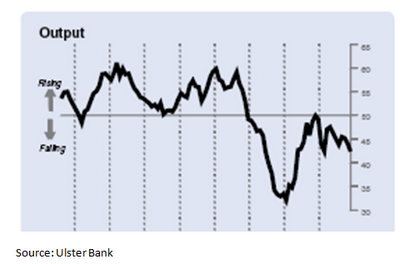
There is no timely official data for the economy in the North that corresponds with the official data for Britain. But the Ulster Bank, a division of RBS, produces monthly PMI surveys for the Northern economy. Surveys of activity by purchasing managers are an internationally reliable method of gauging activity in the private sector. The Ulster Bank output PMI in the North fell again in November 2010, at its fastest rate since April 2009. As the chart below shows, the private sector of the economy has been contracting continuously since the beginning of 2008. Surveys of new business orders and employment have fared even worse.

Chart 1

chart no 1

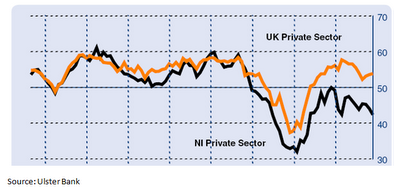
This extended recession in the North is now 12 quarters old, compared to six quarters for the British economy. It is not only now still turning down, but has also been far more severe, as shown in Chart 2.

Chart 2

Chart no 2

Government response

Owen Patterson, the Tory Northern Ireland Secretary, recently made the empty boast that: ‘The [government] Spending Review builds on the measures we took in May and in the Budget in June and will ensure that this country is set firmly on the path to sustainable economic recovery and financial solvency’.

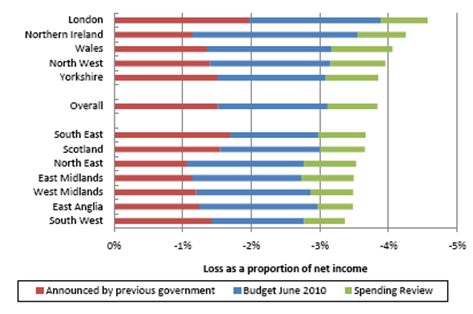
Whichever country he was referring to, the British colony in the North of Ireland was not one of them. With the private sector mired in a much worse recession than in Britain, the Tories’ answer is to cut government spending too. Even worse, the attack on living standards is greater than almost anywhere else. The IFS has conducted research into the ‘regional’ impact of the cuts to benefits and tax changes arising from the Labour Budget of March 2010, as well as the Tory Budget of June 2010 and the Comprehensive Spending Review. It finds only London is more badly hit than the North of Ireland.

Chart 3. Geographical impact of tax and benefit changes 2010–2015

Chart no 3

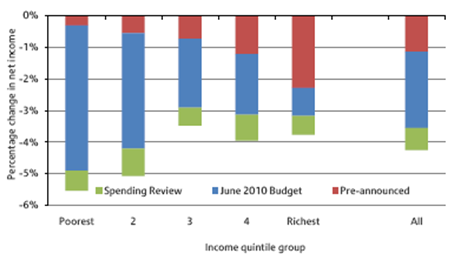
In addition, the poorest sections of the community within the North of Ireland will be hardest hit. As the IFS chart below shows, the poorest are much harder hit by the policy changes than the rich. In addition, in both cases, the Institute for Fiscal Studies (IFS) does not include the impact of changes in services, which of course hit both the poor, and poorer geographical areas harder. In total the effects are much worse than these aspects of taxes and benefits highlighted by the IFS.

Chart 4. Impact of tax and benefit changes 2010–2015 by income group in north of Ireland

Chart no 4

The British government is deepening the economic crisis in the North of Ireland, and its attack is focused on the poorest sections of the population.

The fightback

The Scottish and Welsh Assemblies have already agreed their budgets with Westminster. This is not the case in the North of Ireland as Sinn Féin has opposed the imposition of £4bn in cuts. The Unionist parties and the SDLP were initially willing to accept the cuts. But Sinn Féin’s opposition has forced a repositioning. The campaign has focused on £18bn of investment promised for the North in the St Andrew’s Agreement, which has not been delivered. Sinn Féin has also attempted to build support directly for raising revenues to protect services and support investment, including an ongoing campaign for the repatriation of tax and spending powers which is increasingly popular and supported to some extent by Unionist parties.

It is widely expected that there will be an early general election in the South of Ireland in the first few months of 2011. A key task will be pressing any new Dublin government to insist that the British government meet its £18bn investment commitments, as these were made under international Treaty obligations between two governments. Along with local revenue-raising measures, even a phased introduction of the £18bn would have a powerful antidote effect to the private sector recession and government attacks on living standards.

Even so, this increased investment could do little more than off-set the cyclical effect of the recession and the government attacks. Comparative studies have shown the much lower effectiveness of investment in the North of Ireland than in the South.

From the late 1980s onwards, similar levels of EU investment in both parts of Ireland have produced hugely different outcomes. This is because the North is not at all integrated into the world economy. Participation in the global economy through the international division of labour raises the effectiveness of investment. “Northern Ireland’s” status as a colony of Britain cuts it off from the rest of the world economically — exporting little and importing less.

In this conjuncture, opposition to the cuts and campaigning for increased investment is entirely correct. Otherwise, the Tory-led government would be allowed to degrade the economy of the North of Ireland at a far greater rate even than in Britain. But strategically, the only route towards prosperity for the whole population of the North of Ireland is by breaking the link with Britain.