After the peace process: Where Next for Sinn Féin?

Speech by John McCallister MLA, NI21 Deputy Leader, to Towards a New Ireland conference

A pro-Union member of the Northern Ireland Assembly addressing a Sinn Féin conference in London! Times have indeed changed. I will leave it to others to decide which change is the most symbolic – my presence at this conference, or this conference being held in the first city of the United Kingdom. Seriously, however, I do thank Sinn Féin for the invitation to address this conference and to share my perspective and analysis from a robustly pro-Union perspective. If my comments at any time seem unduly harsh or perhaps unfair. Be assured that such is not my intention. I am here in good faith to promote political dialogue and debate which will aid reconciliation and mutual understanding in Northern Ireland.

The New Ireland?

It is somewhat strange that Sinn Féin has described this conference as “Towards a New Ireland”. I say strange because for the overwhelming majority of people on the island of Ireland. We now live, post-1998, in the New Ireland. We no longer live on an island scarred by conflict. We no longer live on an island in which there is undisguised hostility between Dublin and Belfast. We no longer live on an island in which economic, social, cultural and political relationships stop at the border. We already live in the New Ireland. The New Ireland in which shared interests produce close co-operation between Belfast and Dublin. Shared interests which find institutional expression in cross-border bodies. The New Ireland in which the vast, overwhelming majority of citizens share democratic values and reject the path of violence. The New Ireland in which we realise that the intricate network of relationships in these Islands is not something we can – or desire to – opt out of. It is in this context that Sinn Féin’s campaign for a border poll is distinctly odd. A mere 15 years into these new relationships and new institutions, why should we even consider a border poll. Not least when opinion polls indicate a near complete lack of desire for significant constitutional change? Why seek to inject a toxic dose of 1950s politics into the institutions and relationships of the New Ireland in the 21st century?

The will of the people

To state the obvious – I am not a republican. But one of republicanism’s founding principles – the belief in popular sovereignty – is an honourable principle. The referenda on the Good Friday Agreement were an act of popular sovereignty. The institutions of the Agreement were created and are sustained by the overwhelming consent of the people of the island of Ireland. Contrast that overwhelming consent – that exercise in popular sovereignty – with the latest opinion poll indicating that only 3.8% of people in Northern Ireland want a United Ireland as soon as possible. Popular sovereignty can be uncomfortable for politicians of all persuasions. But the will of the people, North and South, has been given clear expression. The institutions created by the Agreement, the new relationships established by the Agreement, are grounded in the will of the people. And it is not the will of the people to replace the existing constitutional settlement on the island of Ireland with something different. In such circumstances, surely it is in the interests of all of us – in Northern Ireland and across the Island – to heed the will of the people. And focus our energies on delivering on the promise of the institutions and relationships created by the Agreement. In a shared Northern Ireland, in a reconciled Island, in Islands working in partnership. The call for a border poll may satisfy the demands for ideological purity. But it fails in heeding the will of the people, in building on the achievement of 1998.

Making Northern Ireland work

There is another important and destabilising aspect to the campaign for a border poll. Perhaps I can illustrate this by pointing to two words missing from the publicity associated with this conference – ‘Northern Ireland’. The inability of Sinn Féin representatives to utter these two words is not merely cosmetic. When Her Majesty the Queen spoke in Irish at the reception in Dublin Castle, it was not merely cosmetic. It was a historic declaration of respect for the nationalist tradition. When the discourse of unionist representatives embraces both ‘Londonderry’ and ‘Derry’, it is not merely cosmetic. It is a sign of respect for both traditions in the Maiden City. The respect I mention in these two examples both contributes to and is an expression of a desire to build a shared and reconciled society. The campaign for a border poll. The inability to utter the phrase ‘Northern Ireland’. These suggest a hesitancy on the part of Sinn Féin when it comes to building a shared and reconciled community in Northern Ireland. Make no mistake, this is the real challenge and the demanding work for the next generation of politicians and citizens in our part of these of Islands. Perception is, of course, important in politics. Its importance is greatly magnified in a divided society. The perception outside of the republican constituency is that the border poll campaign, and the continued inability to speak of ‘Northern Ireland’ is suggestive of a lack of vision on the part of Sinn Féin when it comes to the political challenge facing us over the next generation.

Post-peace process Sinn Féin?

The peace process has fundamentally transformed relationships within Northern Ireland, on the island of Ireland, and between our islands. These transformed relationships have, in many ways, out-paced our politics. Our citizens, our businesses, and our cultural figures are seeking ways to flourish in and through those transformed relationships. Their reality is a post-peace process reality. Our politics… well, we have some catching up to do. Now, yes, I know that there are challenges for pro-Union political opinion in adapting to the post peace-process relationships and realities. But I am not here addressing pro-Union political opinion. I am addressing Sinn Féin – the second largest party in the Northern Ireland Assembly and Executive. A party with a significant democratic mandate and with significant democratic responsibilities. I know Sinn Féin has travelled far from the 1970s and 1980s. My hope, however, is that the journey is not yet over. In fact, for the sake of our society, the journey cannot yet be over.

Let me illustrate this by asking you to imagine a hypothetical unionist political conference held in another great city in these islands. Imagine it took as its theme the promotion of the integration of Northern Ireland into the rest of the United Kingdom. The same old integrationist certainties from the 1980s would be on display. There would be no need to mention power sharing, or Irish identity or relationships with Dublin. That wouldn’t be needed because integrationist ideology bypassed all those parochial concerns. Such a conference would not be addressing – or listening to – 21st century Northern Ireland or 21st century Ireland. From the imaginary unionist conference let’s turn to today’s Sinn Féin conference. Are you really prepared to address – and listen to – 21st century Northern Ireland and 21st century Ireland? Or do prior ideological convictions, shaped in another era, continue to determine your interaction with the rest of us in Northern Ireland, Ireland and these Islands?

The example of London

I began by thanking Sinn Féin for the invitation to speak at this conference. And I meant it. This is how democratic politics is meant to work – free debate and the exchange of ideas. I robustly and vigorously disagree with Sinn Féin on a wide range of issues. But robust and vigorous disagreement is the lifeblood of democratic politics. So I’ll end with something to promote robust and vigorous disagreement. My belief in the Union is not about ascendancy or sectarian triumphalism. It is about securing the common good for the people of the society in which I live. Having a conference in London demonstrates something of my beliefs. This great city has been defined over centuries by monarchy and parliament. It is here that many of the decisions have been taken – both for good and bad – which have shaped the history of these Islands. This is also a city in which over 175,000 Irish people live and work. London GAA and London Irish are testimony to the presence of the Irish in this city. And on 17th March this year, 10 Downing Street was bathed in green light. This vibrant, dynamic city demonstrates what I believe the Union is about… inclusive and pluralist. Many at this conference will disagree with me. I hope, however, that out of our disagreements and debates can come a shared commitment to building a Northern Ireland for all, in the New Ireland and in a new era in the history of these Islands.


Irish in Britain challenges and changes for the diaspora

Speech by Francie Molloy MP, Sinn Féin, at Towards a New Ireland conference

The excellent attendance and interest in today’s conference underlines just how much Irish people living here in Britain – whether second, third or even fourth generation Irish people, those who’ve been here for a long time, or those who are newly arrived – remain interested and engaged on the issue of Ireland’s political future; its constitutional future and how that affects the relationship between Britain and Ireland. So I’m delighted to see so many different people here from the community and in this particular session.

The fact is that one cannot divorce the political developments in Ireland from the community here – it has a direct correlation and impact. So it makes absolute sense that the diaspora has a crucial role and must have an actual say in both politics at home in Ireland; but also in affecting British government policy here.

Britain’s colonial – both historic and current – role in Ireland is at the root of the circumstances of the diaspora around the world. The huge depopulation of our island is unprecedented in Europe – through conflict, famine and of course the massive scourge of emigration which has sent thousands upon thousands of people overseas for generations – indeed for centuries. Ireland is the only country in Western Europe – probably in the whole of Europe – whose population actually declined since the early 1800s. And of course we are experiencing that now as a consequence of government austerity policies.

So the changes and fortunes of the diaspora are inextricably linked to the political situation In Ireland. That is particularly true for the Irish in Britain. People here suffered clearly in many different ways during the most difficult times of the conflict. People suffered from victimisation, discriminatory policies and an atmosphere comparable to that which the Muslim community is experiencing at the moment. Indeed emigrants from Ireland suffered the same kinds of prejudices and discrimination that many immigrants from British colonies around the world also experienced.

And during that time and despite an atmosphere designed to silence the Irish community about what was happening in their own country, it was by and large Irish people – alongside other people of goodwill here – who did speak out and ensured that political campaigns and discussions in relation to the conflict were kept on the table. That played a crucial role in achieving the peace process and the Good Friday Agreement, and something reflected in the huge support for that here in Britain.

And there is no doubt that the Good Friday Agreement and the peace process has also had a huge impact on the situation of the Irish here in Britain. Irish people here and around the world have of course contributed hugely to the economic, social and political fabric of the country. But most recently that has begun to be recognised and celebrated. The confidence and organisation in the community is clear to see – it has always been there, but with the peace process, people feel more able to participate and stronger in the ability to do that. And that is vital, as there are a number of issues now which we need to keep on the agenda of governments and of the political parties.

So we have some clear changes – what are the challenges?

As Mary and Jenny have both spoken about, there are clear issues for the community here. Politically having a say at home is an important political issue. So that means the right to have a vote. And can I commend Mary and the Votes for Irish Citizens Abroad Campaign for all of the work it has done in regard to this, and getting it on the agenda. We have been pleased to support this campaign from day one.

It is meaningless for the Fianna Fail/Labour government to pay lip service to the diaspora, or to appeal to people to come back to Ireland to spend money and support the economy, when they refuse to give people a say. Indeed, this and previous government’s failed austerity policies are what has driven and is driving people – especially our young people – out of our country. Tory austerity policies are doing the same in the north. And yet people are then disenfranchised and can’t vote.

This is a simple thing to change – a vote for the President, and we also support looking at some kind of vote too in the Oireachtas. We also believe that the vote should also be given to those in the north of Ireland and that there should be real northern representation in the Dáil (for MPs such as myself to represent Irish voters in the north in parliament in Dublin too).

So doing that would give some concrete say for the diaspora.

Secondly, there is a challenge to influence the British government. At present the government is playing fast and loose with the Good Friday Agreement. This can’t continue and the voice of Irish – and progressive – people in Britain has to be heard. We cannot allow the British government to continue to play such a negative role around the peace process. With a Westminster election in the next 18 months, there is a clear job of work to get the issues we discussed this morning on the political agenda. The Irish in Britain organisation and Jennie do brilliant work, with the all-party Irish in Britain group in Westminster as well – to get their voice heard among politicians.

It’s very important to continue to do this. Because as we’re discussing the next phase of the peace process, that has a big effect on the diaspora here. Whether future waves of people are forced to leave Ireland, whether people chose to come here, or elsewhere, or whether people want to choose to go back to Ireland – the connection between our two islands is always going to be very strong.

We believe that a united Ireland is the way forward. That is why we want a serious discussion around this – like we are having today.

Economic benefits of a united Ireland ‘are clear to see’

Speech given by Sinn Féin economy spokesperson, Conor Murphy MP, addressing the ‘Ireland’s Economic Future’ seminar

Conor Murphy and coThere is no doubt that a planned and agreed approach to economic development across the island of Ireland would have a positive impact on trade, investment, economic growth, workforce skills, productivity, innovation, research and development.

Even those politically opposed to reunification do not attempt to contradict this analysis but continue to use unverifiable and unsustainable arguments about dependence on subsistence from the British Exchequer and scare tactics about the ‘South’ not able to afford us.

If they are so secure in these assertions, what do they have to fear by examining the case for economic integration on the island as a precursor to political integration? Sinn Féin believes that there is potential in an all-Ireland situation, with larger economies of scale, with a population of six-and-a-half million people, with all of the different fiscal regulations and transaction costs being regularised, that you will actually create a better economy.

The economic arguments against uniting Ireland being put by those opposed to Irish unity are full of misinformation. Not only is the British Exchequer refusing to provide verifiable figures for revenue generated in the North, but proponents of the union with Britain produce figures that they claim a new national government in Ireland would have to replace, as though absolutely no revenue is generated in the North at all.

A new national government in Ireland would not automatically have to replace the £10 billion subvention that it is claimed the Northern executive receives from the Westminster government.

If you scrutinise the figures – which we have been doing for quite a period of time – the £10 billion actually contains up of £6 billion that you wouldn’t be required to spend in an indigenous all-Ireland economy.

For instance we wouldn’t be helping fund the exploits of the British army, Imperial museums in England, Scotland and Wales, umpteen members of royalty, their entourages and their dozens of residences and the other myriad of areas that are simply to do with the British establishment.

And this doesn’t take account of the savings that would be realised through the elimination of the duplication of every tier and aspect of government on the island of Ireland.

The north cannot realise its full economic potential operating in isolation from the rest of the island while being held to ransom by the stay as we are at all costs ideology of political unionism and island of Britain focused economic policies of the British Exchequer.

Having an all-island corporation tax policy would help create thousands of jobs in the north, yet David Cameron puts his political fight with Scotland ahead of the economic interests of the North of Ireland. An all-Ireland air passenger duty would help in the quest for new routes to Europe, North America, the Middle East and Asia, forging key links to growing economies. It would help attract foreign, direct investors and encourage more tourists to come to our shores. The promotion of the island as a single market would also produce dividends in these areas.

The mantra that the price tag of Irish re-unification is too costly is predicated on highly dubious guesstimates by the British Treasury, Unionist politicians and partitionist elements in the South of Ireland. Accurate figures on all revenue raised and actual expenditure specifically relevant to the north of Ireland are being deliberately withheld by the British Treasury, Excise and Customs and conveniently ignored by successive DUP Finance Ministers.

It does not make economic sense to have an island nation of 6.5 million people split into two separate tax, currency and legal systems, and two separate economies with split populations of 4.6m and 1.9m people in competition with each other. In the context of Irish unity, there would be a sovereign government able to access the full range of fiscal facilities required to build an economy specifically conducive to the needs of the population of the whole island while the additional – and growing – population would contribute through the full range of taxation measures to the Irish Exchequer. It would provide economies of scale and a bigger market with more effective indigenous industries and greater ability to attract FDI. Transactions costs would be eliminated thus leading to greater efficiencies. With national integration we would be in a stronger position to access not only existing European, American and British markets but the emerging markets of South America and Asia.

A new stronger economy arising from the integration of both existing states into a new, agreed Ireland can deliver sustainable economic prosperity that the present status quo is incapable of delivering. We need a new approach to economic development across the island, one which does not promote austerity, perpetuate two fractured economies, and force thousands of young people to emigrate in search of employment opportunities. There is no difference between the effect of the London or Dublin austerity policies that are crippling the lives of our people. But co-operation alone will not deliver prosperity for the people of Ireland. An economy which is built on fairness and equality will deliver a brighter future for all our people in a united Ireland.

There is a better way for the people of Ireland and it is through taking control of our own sovereign economic and political destiny. I challenge those opposed to Irish unity to enter the debate based on full disclosure of accurate economic figures and not on the basis of scaremongering and the misrepresentation of revenue streams.


‘Towards a new Ireland’ – Nessa Childers MEP Conference Speech

London Irish Centre 19th October 2013

childersOther speakers at the conference are addressing important issues such as the holding of a border poll and the question of a Bill of Rights for Northern Ireland. I will suggest that the overriding conclusion from fifteen years of implementation of the Agreement is that we need a new multi-party agreement, linked to a new inter-governmental treaty.

The Good Friday Agreement has delivered much of what it promised. The first and most tangible benefit is the end to killing and maiming. The detailed provisions on rights, equality, policing, justice and so on have worked reasonably well. A limited, but potentially expandable, agenda of North / South integration has been achieved. Relations between Ireland and Britain have never been better. However, the power-sharing Executive has the negative effect of perennially cementing group identities and has made normal governance unattainable.

In their statement marking fifteen years from the Agreement, the Catholic Bishops’ Council for Justice and Peace vividly summarised where the island of Ireland stands today:

‘Those communities worst affected by the violence continue to experience the highest levels of socioeconomic deprivation, unemployment, antisocial behaviour, drug abuse and suicide among young people, in addition to the ongoing threat of paramilitary violence. This situation is mirrored in the most deprived communities in the Republic, where the threat of violence and the lack of hope for the future are part of the daily reality of too many young people.’

The Good Friday Agreement was negotiated on a rising tide of prosperity and self-confidence in the Republic arising from EU membership and globalisation. Utter revulsion at the methods used in the conduct of the thirty years of conflict was also a major factor.

In the North, probably the single greatest factor was war fatigue – on all sides. The IRA finally acknowledged, not only that they could not bomb a million Protestants into a united Ireland, but they had no chance of persuading them either if they continued running a paramilitary campaign. Equally, unionists and loyalists had to accept that nationalist identity and aspirations to Irish unity are entitled to a legitimate space and that the Republic is entitled, as of right, to a say in how the North is run. A decisive factor was the acceptance by the two sovereign governments that a purely internal solution would not work. Now, however, since the seismic financial crash that started in 2008, economic and political confidence has collapsed. As the economic tide has receded, the submerged reefs and rocks of sectarianism are being exposed again. They never went away, you know!

The last twelve months began with the festering controversy over the flying of the union flag over Belfast city hall. We still have the perennial controversies and ritualistic rioting over marches and commemorations. Attacks on the police have escalated, to the point where the Police Federation called for a six-month long moratorium on all parades. Dissident Republicans continue trying to progress their hateful agenda of shootings, bombings and assaults. To this dreary catalogue we may add incidents like the controversial commemorative parade in Castlederg, County Tyrone, the despicable treatment of the Lord Mayor of Belfast when he visited Woodvale to inaugurate a community facility, and unionist and loyalist intransigence over the idea of a peace centre at the site of the former Maze prison.

Is there not a real danger that these events are just the tip of a very deep iceberg of sectarianism? If the two governments continue to ignore this resurgence of sectarianism – and if politicians in the North continue to exacerbate it – how long will it be before these events tip over into a pre-Agreement level of inter-community strife?

Looking back at the factors that led to the Agreement, three conditions seem necessary for a resumption of political development and progress. Both sovereign governments, and politicians on both sides, need to face up to the reality that this continuing, relentless austerity is putting the limited achievements of the Good Friday Agreement under intolerable strain. The struggle to build peace on the island is inextricably bound up with the campaign against austerity.

The second pre-requisite is for the two sovereign governments to prioritise and re-engage with maintaining and enhancing what has been achieved under the Good Friday Agreement. The only time there has been real political progress is when the governments have been closely involved.

The third essential element is the re-emergence of independent, international third party facilitation. The president of the US Council of Foreign Relations, an experienced diplomat, Richard Haas, is chairing talks that are intended to tackle some of the most divisive issues, like parades, flag and emblems. The All-Party Panel includes representatives from the Assembly parties and will present a set of recommendations that will be supported by all the parties, before the end of the year.

However, the reported agenda and ambition of these talks is too limited. The key to progress is not just to tweak the existing Agreement, but to move decisively to a new one. One that learns from the successes – but more importantly – the failures of Good Friday Agreement One and that absorbs the lessons of the past fifteen years of implementation.  There should be no prior limitations placed on where the Haas discussions might go or what they might lead to. Good Friday One is not the terminus of peace and normality. It is merely a bus stop on the road there.

What is even more important than setting out a specific agenda for talks is the spirit in which the parties approach talks. The parties need to move beyond a mechanistic ‘tit-for-tat’ understanding of parity of esteem, where one side or the other will not make a political concession unless guaranteed a response by the other. It is time for ‘generosity of esteem’, as well as ‘parity of esteem’.

This approach is illustrated by the story of my own family. My grandfather, Erskine Childers, served twice in the British forces: firstly, in the Boer War and secondly during World War I. He migrated from being a Liberal Party Home Ruler to a Sinn Féin TD in the first Dáil and, ultimately, one of the fiercest opponents of the Treaty. He was executed by firing squad on 24th November 1922 for possession of an ornamental pistol, given to him by Michael Collins two years earlier as a wedding present. On the night before his execution, in his condemned cell, he charged my father with the responsibility of shaking the hand and forgiving every member of the Free State cabinet who had condemned him to death. My father carried out that solemn duty.

That is the kind of spirit of esteem we need to display now to move the Good Friday Agreement forward.  We – the leaders, politicians and people on both sides – need to grasp and shake the hands, and finally forgive, those who, in the past, would have condemned us to death politically, if not literally. We need to recall, and live, the lines of Michael Longley’s wonderful poem ‘Ceasefire’, which might well have been written about my grandfather’s act of reconciliation:

‘I get down on my knees and do what must be done
And kiss Achilles’ hand, the killer of my son’.

Enda Kenny is wrong to claim that austerity is coming to an end

By Michael Burke

First published via The Guardian, Wednesday 16 October 2013

The Irish economy remains in depression. It is the ECB’s bailout of the banks we are being invited to celebrate.

Ireland is being held up once more as the star pupil of the austerity school of economics in Europe, with the taoiseach, Enda Kenny, arguing that his government is exiting the bailout programme set by the troika of European Union, the European Central Bank and the IMF. He says the era of austerity is coming to an end.

Both of these claims are clearly questionable, but they do illuminate some important features of the situation in Europe – including Britain.

The policy of the Dublin government will continue to be set by the troika for many years to come. In fact the EU has already put in place a system of budget monitoring, regulation and even sanctions that will enshrine permanent austerity for all members of the euro. In addition, it has become customary for the IMF to put in place a new credit facility once initial bailout money runs dry which has its own strings attached. Therefore it is untrue that austerity is at an end. Instead, the assets and loans held by Irish banks have become so devalued as a result of economic weakness that the risk of a new bailout for their creditors is rising.

There is also an important reason why Ireland cannot be emulated by countries such as Greece and Portugal. At the outset of the crisis, the Irish economy was vastly more prosperous. And after a prolonged slump across the European periphery, that remains the case. One measure of the failure of successive Dublin governments is that living standards have fallen so far that they have fallen back towards British levels, having pulled ahead before the turn of the last century.

There is always a chorus in Britain that wants to ascribe all economic ills to the EU. But George Osborne’s threat to maintain austerity until at least 2018 and to aim for budget surpluses matches the perma-austerity of Brussels, Frankfurt and Washington. The lazy assertion of British eurosceptics of both left and right, that we are better off outside the euro, is disproved by the fact that in international currency terms the British economy has contracted by more than any other country. Britain has not prospered from devaluation.

Similarly, the outbreak of self-congratulation both sides of the Irish Sea is entirely misplaced. The recent self-criticism from the Office for Budget Responsibility regarding its own hopeless forecasting record includes a clear verdict that the source of the very weak recovery in Britain is an unexpected increase in government consumption.

Dublin governments tend to lack the age-old arrogance of the British political elite and so seek plaudits abroad. The governing coalition of the right-wing Fine Gael and Irish Labour parties looks to be patted on the back or perhaps the head, for a forecast that government finances will shift into what is called a primary surplus, that is a surplus on government finances before interest payments are taken into account. But this is a claim increasingly made by supporters of the governments implementing austerity in Portugal and Greece too, and is largely meaningless. Unless the growth rate of the economy exceeds this growing interest bill, the level of government debt becomes unsustainable.

But for the time being the immediate risk of government default has been sharply lowered. This is partly due to the commitment of the ECB to “do whatever it takes” to maintain the euro. Whatever extends to unlimited for bailouts for creditors, mainly European and British banks, but not a euro for the governments.

It is this life-support operation for the banks we are now invited to celebrate. The party is likely to be short-lived, as austerity is hollowing out the economy. Without investment, productive capacity declines. In Ireland, net new investment (after deducting depreciation, wear and tear and so on) is close to zero. The economy remains in a depression, one of whose effects is to pile up bad loans at the retail banks, including distressed mortgage payers. Austerity is the enemy of growth and cannot resolve the crisis.

Prosperity in the debate about the Union vs a United Ireland

By Michael Burke

The question of economic prosperity is not as central as it might be in the debate on the de/merits of the Union with Britain or a United Ireland. This is a large topic, but it is important to set out some facts that might serve to inform that debate and help to push this issue up the agenda.

The key issue in all economics is, what determines the optimal growth in the living standards of the population? A key measure of that is the level and growth rates of per capita GDP.

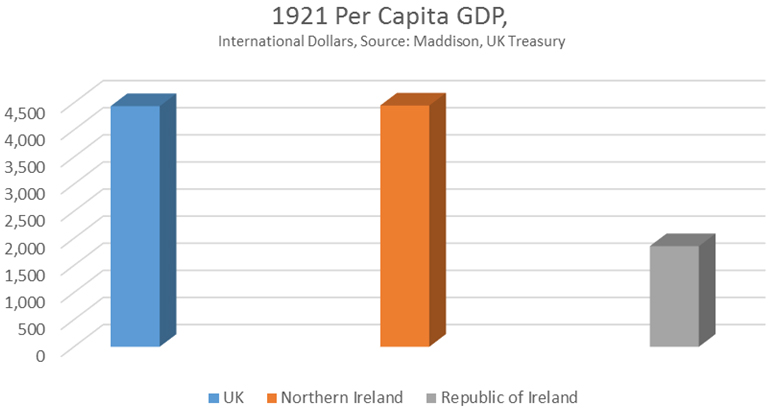
Chart 1 shows the levels of per capita output in 1921 in what were later to become Northern Ireland, the Republic of Ireland and the UK.

Chart 3

The industrial area around Belfast had long been the most prosperous part of Ireland and enjoyed a particular boom during the course of the First World War. As a result, despite the post-WWI decline, UK Treasury estimates show that per capita GDP was fractionally higher in NI than the UK as a whole at that time. By contrast, outside of Dublin the rest of Ireland was largely rural. On UK Treasury estimates at the time of Partition, per capita GDP in what is now the RoI was 45% of the level of what is now Northern Ireland.

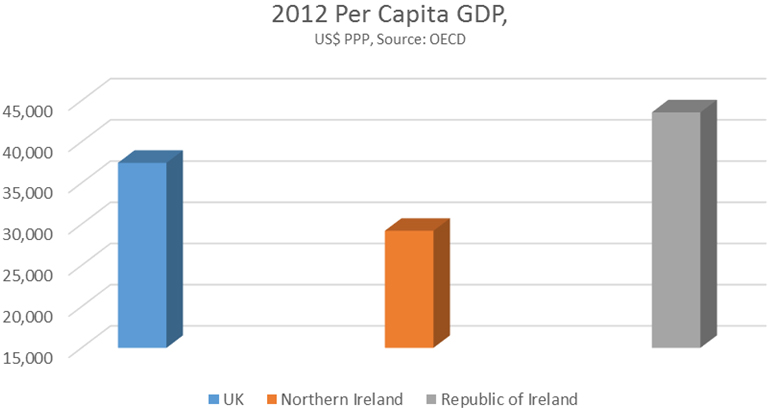
Chart 2 shows the most recent data, from the OECD (using their estimates of Purchasing Power Parities, which are comparable but not identical to the Maddison data cited above). This shows two opposite trends. In the 90 years following Partition, per capita GDP in the RoI has caught up and then surpassed that of the UK (around the turn of the 21st century). Meanwhile per capita GDP in Northern Ireland has relatively declined, to just under 80% of the level in the UK. While incomes in the North have grown fivefold in 60 years, in the South they have grown twentyfold.

Chart 2

There can be no single explanation for these trends. But similar trends have been noted elsewhere. In particular, colonies always face two key problems in relation to the metropolitan centre relating to the relative lack of investment and ‘closed’ trade patterns (not integrated into the world economy through trade).

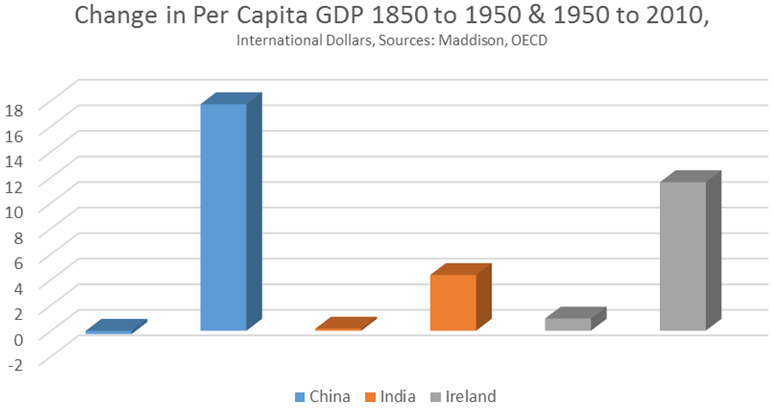
This can be illustrated by Chart 3, which shows three former colonies of Britain and their cumulative growth pre- and post-independence. The three colonies are China, India and Ireland. For each country the 100-year period of growth in per capita GDP between 1850 and 1950 is shown (Maddison).

For China there was no growth of this measure at all over the course of a century. Per capita GDP actually fell by a quarter under British/French/US and then Japanese rule. In India, per capita GDP grew by one-sixth over that period while in Ireland it almost doubled.

Chart 3

However, taking the shorter period from 1950 to 2010 the growth rates of per capita GDP have been transformed (Maddison & OECD). In India per capita GDP has increased by over 330% in 60 years. In RoI it has increased by more than 10 times. In China it has risen by more than 16 times.

It might be argued that this was simply a tendency to ‘catch-up’ with the living standards of more advanced western economies. But that would not explain why Ireland was able to surpass the UK at the end of last century. Crucially, it cannot explain why that catch-up did not occur in any case while the three countries remained colonies.

The technical objection that Irish GDP is inflated by the tax accounting activities of multinational companies is valid and widely-known. But so too is Britain’s GDP inflated, though less discussed, through its related network of ‘offshore’ financial centres. If undistorted measures such as value added in industry are used, the same conclusion is drawn: per capita outout in the RoI surpassed the UK before the turn of this century.

This does not exhaust the questions relating to economic policy and Northern Ireland’s place in the Union or its potential place in a United Ireland. Neither should it be interpreted as an endorsement of the economic policy of successive Dublin governments. But it does highlight the difficulties of colonies in maintaining relative prosperity and their greater potential to prosper once the colonial status has ended.

‘Towards a new Ireland’ – Aaron Kiely on the upcoming conference

First Published in Student Broad Left on 7th October 2013

Aaron Kiely, NUS Black Students’ Officer writes on why students should attend the ‘Towards a new Ireland’ Conference on 19 October and also why Student Broad Left is delighted to have Daithi Doolan from Sinn Fein speak at ‘Student Fightback 2013’ on Saturday 12 October.

This month I will be very pleased to be joining a panel with prominent speakers from Ireland and Britain at the `Towards a new Ireland’ conference on 19 October at the London Irish Centre.

Sinn Fein is hosting the conference and their party President, Gerry Adams, will be among a very wide range of speakers, including senior Labour Party representatives and trade union leaders. I’m delighted to have the opportunity to be part of this event, as I believe that the issue of Ireland is very important to progressive people here in this country – and an issue where the unfinished business of self-determination has to be addressed.

Because of my own Irish heritage I have always had an interest in Irish politics. But many young people and activists in the student movement will be unfamiliar with why the issue of Ireland is something they should be interested in today. The historic peace process in Ireland has seen a massive, positive transformation in Ireland itself, and in relations between Britain and Ireland. Many of us whose political consciousness has been raised by struggles in Palestine and Latin America or against racism will not have had direct knowledge of the history of struggle in Ireland and the political issues underpinning that. We have largely grown up during a time of peace with Ireland. The huge success of the peace process can be interpreted to many as the end of the matter — that the issue of Ireland is settled and so not on the political agenda. However, this is far from the truth – many key issues which led to the conflict, and its resolution, have yet to be fully resolved.

The fundamental reasons for the Good Friday Agreement, and the conflict which preceded it, have parallels with many other struggles around the world. These can be found in the colonial relationship between Britain and Ireland, the discrimination and sectarianism in the north of Ireland as an institutional part of the state, the brutal repression of the movement for civil rights which opposed that, the subsequent involvement of British troops being sent in and being opposed, and the ongoing violent conflict which arose and successive British government failed policies, in relation to that. We have seen the divide and rule policies, the absence of justice, denial of democratic mandates, criminalisation and the insistence of military solutions to political problems, all accompanied by a campaign of misinformation. In fact it is no accident that there are strong historic links between Ireland’s struggle and other anti-imperialist struggles around the world. For example in Havana, there is a plaque which reads `Cuba and Ireland – two island people in the same sea of struggle and hope’. The parallels of small nations with larger neighbours, struggling to assert their own independence are obvious to see. Or the strong connections between Ireland and Palestine, which one can see reflected in murals in Belfast and Derry, alongside depictions celebration the anti-slavery struggle and many other progressive struggles in history.

Sadly, in Ireland and Britain, like many other parts of the world today, many thousands of lives were tragically lost over those recent decades, families torn apart by loss, in what was seen to be an intractable conflict.

Yet, through some strong political leadership, the peace process did emerge and the Good Friday Agreement – some 15 years old this year – was agreed as an international agreement with the consent of the majority, north and south. Core points of the agreement, and the process which led to it were inclusivity in negotiations, recognition of political mandates, and an adherence to the principles of equality and self-determination. There was a recognition of the legitimacy of all political aspirations, not just one. This level playing field was created as a framework for moving forward. It was not an endgame in itself, but a process.

For me, a united Ireland, free from British involvement is, in my view, the progressive position. Ultimately it is up to the people of Ireland to decide and we should both support that basic self-determination and be persuaders for Irish unity here in Britain as well. Immediately that means supporting the Good Friday Agreement and opposing those who wish to take things backwards.

Unfortunately the current Tory government has been strongly criticised for failing to fulfil all of the obligations of the agreement, and playing a largely negative role when it does get involved.
Importantly for progressive and left people here, we can learn a huge amount from the experience of the struggle and the political process which has taken place in Ireland and have a part to play in supporting this next important phase of the peace process. That is why joining the conference on 19th is so important. Ireland’s unfinished business is something we should be interested in and continuing to show our solidarity.

Finally, I will join the discussion on a `Democratic Ireland – for an island of equals’. This session will look at what the new relationship between a new Ireland and Britain might be like. It is not simply a question of making constitutional changes to the status quo. It also means building alliances in Ireland, and between our two islands, based on equality for all, opposing racism, economic and social justice and for a progressive alternative. I shall therefore be delighted to be joining CWU Ireland President Cormac O Dalaigh, Sinn Fein’s and Ireland’s youngest Senator Kathryn Reilly and the executive director of the Northern Ireland Council for Ethnic Minorities, Patrick Yu at that session.

Other sessions will see a range of brilliant speakers including Diane Abbott and Jeremy Corbyn, Kevin Maguire from the Mirror, Irish Congress of Trades Unions President John Douglas, and cross-party representatives from Ireland, north and south.

I am equally delighted that Daithi Doolan from Sinn Fein will be among speakers at our Student Fightback conference on the weekend before – to join the debate on the alternatives to cuts and austerity and to make some of this crucial links between economic underdevelopment of countries hit by both austerity and the legacy of colonialism and the alliances and understanding we can build.

Come along to Student Fightback, but also to Towards a New Ireland on 19th and join in the discussion and ensure we put Ireland on our agenda. There is much to be learned and this will be a fantastic opportunity to do so.

Register: www.londonirishunity.com

Towards a new Ireland: Join the discussion

First Published in Socialist Unity on 19th September 2013

By Sean Oliver, Sinn Fein International Department (Head European/Britain Section)

This month inter-party talks get underway in Belfast, chaired by US senior diplomat Richard Haas, aimed at driving forward some progress around key issues in relation to the peace process in Ireland. The backdrop to this has been some months of loyalist violence – largely focused in parts of Belfast – and the role of political unionism in relation to that. Sinn Fein have strongly criticised the obstruction in moving forward the Good Friday Agreement (GFA) and the current phase of the peace process, and many parties, including the Alliance and others have attacked the DUP and some in the UUP leadership’s role in encouraging the so-called flags protest.

Sinn Fein recently criticised Tory Secretary of State Theresa Villiers for, on the one hand, failing to fulfil the British government’s responsibility to the GFA as an international agreement, whilst on the other hand attempting to restrict the Haas talks from addressing core issues, such as dealing with the past — and in particular the role of the British state.
Meanwhile, Sinn Fein MP Conor Murphy expressed concern at the Dublin government’s disengagement with the process, having an equal responsibility as co-signatories.

Largely absent from the British media, yet these issues remain important for the left and the labour movement in Britain. Why? Fundamentally, while there has been immense progress in securing progressive political change through the process in Ireland, much remains to be done. Ireland’s constitutional future is still very much an issue, put firmly on the agenda by the GFA. In essence Britain remains a colonial power in Ireland and, whilst many try to portray the current process as a final settlement, it in fact lays out a level playing field in which the issues of national democracy can be argued for. Progressives in Britain have a clear role to play in putting pressure on the British government and in playing a part in ensuring Ireland’s right to self-determination — as laid out in the GFA — is fulfilled. Clearly the Irish community in Britain, which is gaining strength and confidence, and is embedded in the labour movement, has a vital role to play.

Moreover, as right wing governments across Europe seek to impose austerity and attacks on the working class, it is imperative to build alliances with progressive and left parties across Europe. In Ireland, Sinn Fein’s arguments for a new, united republic in Ireland are underpinned by a framework of social and economic equality — and an obvious ally for likeminded parties and groups in Britain.

It is for this reason that Sinn Fein are hosting a major conference `Towards a new Ireland’ in London on 19 October. Party president Gerry Adams will give a keynote speach and join a wide range of speakers, unprecedented in their political breadth, to discuss these issues. Trade union leaders will join this discussion, including Irish Congress of Trade Unions President John Douglas and CWU Ireland President Cormac O Dalaigh, reflecting the importance of the alliances with the trade unions. Sinn Fein workers’ rights spokesperson Paul Maskey was at the recent TUC Congress and a large Sinn Fein delegation will be at next week’s British Labour Party conference in Brighton, taking these issues up there, including at the party’s fringe on Sunday evening which will discuss what Labour’s approach should be.
The conference on 19 October will be an important and timely opportunity to take forward this discussion.

`Towards a New Ireland – a new phase of the peace process’. Saturday 19 October, London Irish Centre, 50 Camden Square, NW1 9XB. 10am-5pm (doors open 9.15am).

Registration via: http://www.londonirishunity.com/

Fianna Fail leader all talk but no action on all-Ireland co-operation

Sinn Féin MP Conor Murphy, who will be speaking at the Towards a New Ireland Conference on 19th October, has criticized successive Irish Governments for their failure to oversee the full implementation of Agreements arising from the Peace Process.

Commenting in the Belfast-based ‘Irish News’ on recent remarks by Fianna Fail Leader Micheal Martin, the Newry/Armagh MP said that in government Martin did little to develop an all-Ireland economic model and called on the Fianna Fail leader to support the demand for a referendum on Irish unity.

Conor Murphy said:

“Micheal Martin’s recent comments regarding complacency on the part of the British and Irish Governments in relation to the Peace Process is a point consistently raised by Gerry Adams with the Irish Government and directly with the British Prime Minister by Martin McGuinness.

“Both Governments are co-equal partners and guarantors of the agreements arising from the Peace Process. Yet both governments, including those in which Micheal Martin was a Minister, failed to oversee the full implementation of the agreements they entered into.

“The only way to build a stable economic future across this island is to unleash the economic potential of an integrated all-Ireland economy. But realising that vision requires the full and active participation of the Irish Government and I have to say that Micheal Martin while in government did little to develop an all-Ireland economic model or to develop additional areas of co-operation.

“A point in case — the St. Andrews Agreement, provided for a review of all-Ireland bodies and the development of new areas of co-operation. Under Micheal Martin’s watch the Irish Government failed to progress this review or bring forward proposals when in a position to do so.”

Regarding Martin’s comments on recently secured economic investment for the North, Murphy said:

“Sinn Féin was central to securing the significant investment of £18 billion of capital investment for the North and greater flexibility in borrowing powers which will provide the much needed infrastructure required to reinvigorate the economy.

“This Economic Pact provides for a review of fiscal powers for the North. This is a significant achievement, as enhanced fiscal powers will provide the Executive with the ability to address all-Ireland development and harmonisation free from the current restrictions imposed by Westminster.

The Sinn Féin MP called on Micheal Martin and Fianna Fail to support the call for a referendum on Irish unity:

“The Good Friday Agreement provides for a poll on Irish unity. Securing a Border Poll means building support so that the Irish and British governments are moved to fulfill their obligations to hold one. A Border Poll provides a unique opportunity for a real, inclusive and constructive debate on the future of Ireland.

“This is a priority for Sinn Féin. It would be helpful and refreshing if Micheal Martin’s Fianna Fáil were to support this call. It’s time to let the people have their say.”


Fianna Fáil long on rhetoric, short on action when it comes to all-Ireland approach

Pádraig Mac Lochlainn TD

Sinn Féin TD Pádraig Mac Lochlainn has responded to remarks by Micheál Martin at the Merriman Summer School, saying that when it comes to the issue of deepening and developing an all-Ireland approach to politics, Fianna Fáil is long on rhetoric and short on action.

Deputy Mac Lochlainn said:

“The Peace Process remains a work in progress and needs the constant attention and support of the Irish and British Governments. Sinn Féin has raised this issue directly with the Taoiseach on a number of occasions and in the Dáil.

“If Micheál Martin’s comments at the Merriman Summer School represent a conversion by Fianna Fáil to the importance of all-Ireland politics, it is of course to be welcomed.

“However, the real test of any party’s commitment is their record in government. In this regard Fianna Fáil did little to expand on the all-Ireland institutions or to provide for Northern representation in the Oireachtas.

“When it comes to the issue of deepening and developing an all-Ireland approach to politics, Fianna Fáil is long on rhetoric and short on action.

“In fact, Micheál Martin in particular has consistently viewed the North as a mere political football in his electoral battle with Sinn Féin in this State, doing a grave disservice to all-Ireland objectives.

“Sinn Féin, which commands the electoral support of the vast majority of nationalists in the North, has consistently demonstrated real political leadership in seeking to build a shared future between unionists and nationalist Ireland.

“Last year’s handshake between Martin McGuinness and the British monarch was symbolic of Sinn Féin’s commitment to demonstrate to unionists that republicans accept and respect their identity and that the new Ireland we seek to build is inclusive of all traditions on this island.

“Meanwhile republicans in the North are working day and daily at interface areas to reduce tensions around contentious issues and to build a shared understanding with unionist communities.

“If Micheál Martin is genuine about these issues he needs to support Sinn Féin in our efforts, for instance, to have fiscal powers devolved to the North’s Assembly, to ensure northern representation in the Dáil, that Irish citizens in the North be given the right to vote in Presidential elections and for a poll on Irish unity.”